

Article by
Jake Blasco, B-2 Licensed Contractor
Jake Blasco leads design and project planning at Blueprint Kitchen & Bath Design Studio, specializing in kitchen, bath, and whole home design in Huntington Beach and surrounding Orange County communities. His approach combines thoughtful layouts, quality materials, and practical construction knowledge to create spaces that look beautiful and work for everyday life.
Jake shares guidance on cabinetry, countertops, finishes, lighting, and renovation planning to help homeowners make informed decisions. As the qualifying individual for Blueprint’s California B-2 Residential Remodeling license (CSLB #1161570), he brings a construction perspective to every design.
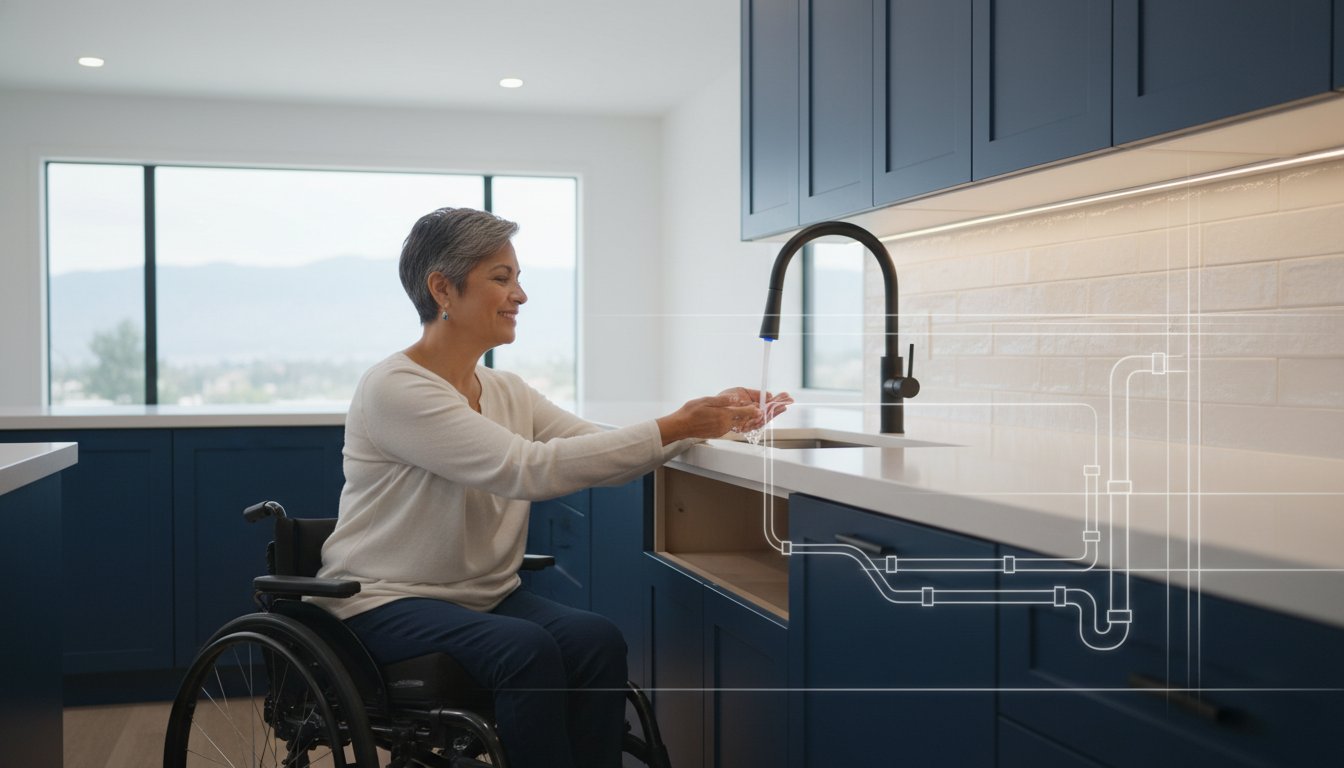
What if the most frequently used tool in your kitchen was designed to support your movement rather than challenge it? For many homeowners, standard twist handles and deep reaches turn simple tasks like filling a pot into a source of physical strain and frustration. You likely believe that your home should adapt to your needs, providing comfort without compromise. Professional accessible kitchen faucet installation bridges the gap between clinical necessity and high-end home aesthetics, ensuring your kitchen remains a place of comfort and independence.
We'll help you find a solution that requires less than five pounds of force to operate and eliminates the need for tight grasping or pinching, meeting the precise standards for modern accessibility. This guide explains how to select and install the perfect faucet to enhance safety and autonomy in your home. You'll learn about ergonomic lever handles, touchless sensor technology, and the technical steps required for a leak-free, reliable upgrade that integrates seamlessly into your daily routine.
Key Takeaways
- Learn the technical requirements of the ADA 309 standard to ensure your hardware requires no tight grasping, pinching, or twisting of the wrist.
- Evaluate the practical benefits of touchless motion-sensors versus single-handle lever faucets to find the best solution for your specific dexterity needs.
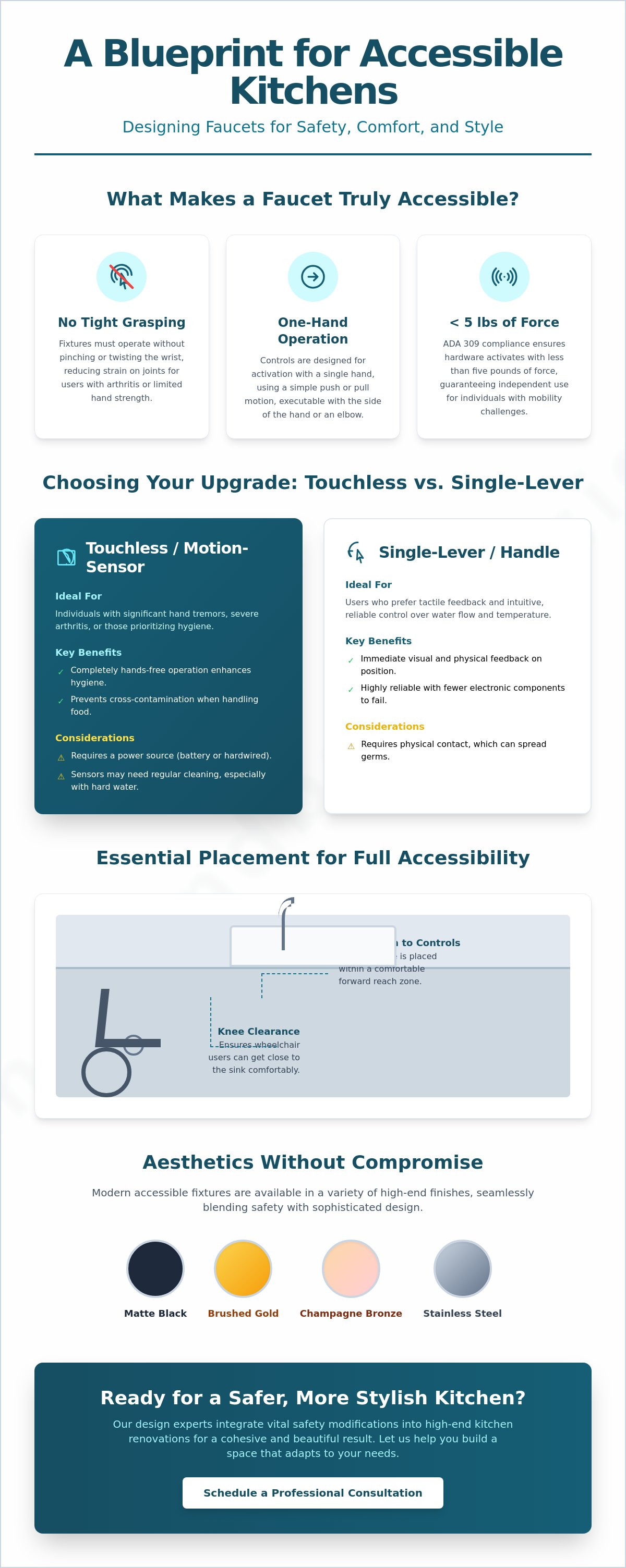
- Identify the optimal reach depth and placement strategies, including essential knee clearance, to ensure the sink is fully accessible for wheelchair users.
- Master the fundamental steps for a successful accessible kitchen faucet installation, from gathering specialized tools to securing a leak-free connection.
- Discover how specialized design experts integrate these vital safety modifications into high-end kitchen renovations for a cohesive and stylish result.
Understanding Accessible Kitchen Faucets: Beyond ADA Compliance
True accessibility in the kitchen begins with hardware that works with you, not against you. An accessible faucet is defined by its ease of use; it requires no tight grasping, pinching, or twisting of the wrist to operate. For individuals managing arthritis or limited hand strength, these mechanical details are the difference between a functional kitchen and a frustrating one. By prioritizing "one-hand operation," homeowners can maintain their autonomy while reducing daily strain on sensitive joints.
While many people associate the ADA 309 standard with public facilities, its application in home remodeling is a cornerstone of safe, long-term living. These regulations ensure that controls are operable with minimal effort. This approach aligns with broader Universal Design Principles, which focus on creating environments that are usable by everyone, regardless of their age or physical ability. Planning for an accessible kitchen faucet installation early in your renovation ensures that your space remains practical for years to come.
To better understand how these accessible features function in a real-world setting, watch this helpful video:
The "No-Grasp" Rule: Why It Matters
Traditional round knobs require a firm grip and a rotating motion that can be painful for those with joint inflammation. In contrast, lever handles allow for a simple pushing or pulling motion that can be executed with the side of the hand or even an elbow. Proper accessible kitchen faucet installation ensures that these ergonomic benefits are fully realized by placing the lever within easy reach of the user. To meet ADA compliance, the hardware must not require more than 5 pounds of force to activate. This ensures that even those with significant mobility challenges can control water flow and temperature independently. Accessibility hardware must function without any twisting or turning of the wrist.
Aesthetic Accessibility: Style Meets Safety
Choosing safety doesn't mean you have to sacrifice the visual appeal of your home. Modern manufacturers now offer ADA-compliant models in sophisticated finishes like matte black, brushed gold, and champagne bronze. These fixtures allow you to avoid the "institutional look" often found in hospital settings, blending perfectly with high-end cabinetry and stone countertops. Integrating these elements is a key part of Professional Grab Bar Installation in Redlands, CA and other safety-focused upgrades. When safety is integrated thoughtfully, it becomes a seamless part of a beautiful, modern home.
Comparing Handicap Kitchen Upgrades: Touchless vs. Single-Handle
Choosing the right fixture is a pivotal step in accessible kitchen faucet installation. It's about matching the hardware to the user's specific range of motion and sensory feedback needs. While touchless models offer a "hands-free" experience, traditional single-handle designs provide a tactile reliability that many users find more intuitive and easier to control.
When Touchless is the Best Choice
Motion-sensor faucets are ideal for individuals with significant hand tremors or severe arthritis. They prevent cross-contamination by removing the need to touch a handle with messy or unwashed hands. When selecting these units, you'll need to choose between battery-powered models or hardwired options. Local water conditions in Redlands often include higher mineral content, which can occasionally interfere with the delicate sensors of touchless models; regular cleaning of the sensor eye is essential to maintain consistent responsiveness.
The Reliability of Single-Lever Designs
Single-handle lever faucets remain a staple in accessible kitchen faucet installation because they offer immediate visual feedback. The position of the lever clearly indicates the water temperature and flow rate, which helps prevent accidental scalding. Evaluating these fixtures requires a "dry run" to test the resistance of the lever. A high-quality ceramic disc valve ensures the handle glides smoothly with minimal effort. Longer handles provide better leverage, making them much easier to operate for those with limited hand strength or dexterity.
Voice-activated technology is becoming a popular choice for modern aging-in-place remodeling. These systems allow for precise water measurement and temperature control through simple verbal commands. This eliminates the need for physical interaction entirely, which is a significant benefit for those with severe mobility restrictions. On the other hand, pull-down sprayers offer a mixed benefit. They help users reach the entire sink basin without leaning forward, but the weight of the spray head can cause shoulder fatigue. A lightweight, magnetic docking system is often the best choice to ensure the sprayer returns to its seat without requiring a forceful push.
Integrating these fixtures into a cohesive accessible kitchen design ensures that every element of the workspace supports your independence. A professional assessment can help determine which technology best fits your daily routine and physical capabilities.
Essential Placement and Reach Requirements for Accessibility
The success of an accessible kitchen faucet installation depends entirely on the spatial relationship between the user and the fixture. Even the most ergonomic handle is ineffective if it sits beyond a comfortable reach. For individuals using wheelchairs or those with limited upper body mobility, the geometry of the sink area must be calculated with precision to ensure every task remains within a safe range of motion.
A critical factor in this layout is the "reach depth," which refers to the distance from the edge of the counter to the faucet's controls. To maintain stability, this depth should not exceed 20 to 25 inches when an obstruction like a countertop is present. If the reach is too deep, the user is forced to lean forward, which can lead to loss of balance or physical strain. This requirement is closely linked to the knee clearance provided beneath the sink. When a cabinet is modified to allow a wheelchair to roll under the basin, the user can get closer to the hardware, effectively reducing the reach distance required to operate the water.
Managing obstructions like deep-basin sinks or high backsplashes is another essential consideration. A deep sink might seem like a benefit, but it can actually force a user to reach further down and forward, increasing the load on their lower back. Choosing a shallower basin or a faucet with a longer spout can help bridge this gap, ensuring that water is delivered exactly where it's needed without requiring the user to overextend.
Calculating Reach Range and Depth
Standard accessibility guidelines specify a 48-inch maximum high forward reach for controls. However, in a kitchen environment, the presence of the sink basin complicates this measurement. You should measure from the front edge of the counter to the furthest point of the faucet handle to ensure it stays within the user's personal comfort zone. Placing the faucet on the side of the sink allows a wheelchair user to operate the controls without reaching over the entire basin. This side-approach positioning significantly improves ease of use and reduces the physical effort needed for daily chores.
Clearance and Mounting Considerations
During the planning phase of your accessible kitchen faucet installation, you must also account for the physical "swing" of the handle. Many single-lever models require several inches of clearance behind the faucet to move into the full hot or cold positions. If the faucet is placed too close to a high backsplash, the handle may hit the wall, preventing the user from achieving the desired water temperature. Deck-mount faucets are generally preferred for these modifications because they offer more flexibility in placement compared to wall-mount units, which are fixed in height and depth. Additionally, ensure the height of a high-arc spout does not interfere with the bottom of upper cabinets, especially if the sink area has been raised or lowered to accommodate a specific user's height.
Step-by-Step Accessible Kitchen Faucet Installation
Transitioning from the planning phase to physical execution requires a methodical approach. A successful accessible kitchen faucet installation relies on having the right specialized tools and a clean workspace. You'll need a basin wrench to reach the mounting nuts in the tight space behind the sink, adjustable pliers for the supply lines, and plumber’s tape to ensure watertight threads. Before you begin, shut off the water supply valves under the sink and open the faucet to drain any remaining pressure. Removing the existing hardware is often the most labor-intensive part; using the basin wrench correctly prevents damage to the sink deck.
Preparing the Sink Deck
Once the old fixture is removed, thoroughly clean the mounting surface to remove old putty or mineral deposits. This step is vital for creating a watertight seal that prevents future sub-cabinet water damage. If your new faucet has a single-hole design but your sink has three holes, use a deck plate, also known as an escutcheon, to cover the extra openings. This maintains a high-end aesthetic while providing a stable base for the new hardware. Apply silicone or use the included rubber gaskets according to the manufacturer’s specifications to secure the unit.
Connecting the Water Lines and Sensors
Modern touchless faucets often require pre-assembling sensor components before mounting. When connecting flexible supply lines, tighten compression fittings by hand first, then give them a quarter-turn with pliers. Over-torquing can damage seals and cause leaks. Mount the electronic control box in an accessible spot for future battery changes. Verify that pull-down weights move freely without snagging on pipes. This ensures the sprayer returns easily, maintaining the unit's accessibility and preventing unnecessary physical strain during use.
The final step is testing the system under pressure. Turn the water back on slowly and check every connection point for moisture. Once the water is running, verify that the handle or sensor operates with less than five pounds of force. This ensures the installation truly meets the needs of those with limited hand strength. If you find the technical requirements of this process overwhelming, consider consulting a specialist in accessible kitchen design to handle the technical details for you. A professionally vetted installation provides the peace of mind that your home remains both beautiful and safe.
Why Professional Installation in Redlands Matters
A professional accessible kitchen faucet installation is more than a simple plumbing task; it is a critical component of a broader safety strategy. In the Redlands and San Bernardino County area, homeowners often face the challenge of updating historic or traditional homes to meet modern mobility standards. Working with a SHSS Certified Senior Home Safety specialist ensures that your hardware isn't just "compliant" on paper, but truly functional for your specific physical needs. This specialized expertise allows Blueprint Kitchen and Bath Design Studio to bridge the gap between clinical necessity and high-end home aesthetics, creating a space that feels like a lifestyle upgrade rather than a medical modification.
The Blueprint Safety Assessment
When our experts evaluate a home, we look far beyond the sink basin. We understand that a faucet is only accessible if the user can safely reach it. Our comprehensive assessment identifies potential hazards throughout the room, looking at the interplay between lighting, slip-resistant flooring, and doorway widening to ensure a seamless path of travel. This holistic approach provides the peace of mind that comes from a professionally vetted environment. By choosing a certified specialist for your accessible kitchen faucet installation, you also secure the long-term reliability of your hardware. Professional mounting and calibration protect your manufacturer warranties and prevent the structural water damage that often results from DIY plumbing errors.
Customizing Your Accessible Kitchen
Every mobility journey is unique, and your kitchen should reflect that reality. We tailor hardware choices to the specific challenges of the individual, whether you are managing the joint inflammation of arthritis or the hemiparesis associated with stroke recovery. A single-handle lever that works for one person might be less effective than a touchless sensor for another. Our studio understands the specific Redlands building codes and ADA residential standards, ensuring that every modification is both legal and life-enhancing. We treat every project with the integrity of a "Specialized Guardian," prioritizing your physical autonomy and the long-term stability of your home.
True independence in the kitchen is achieved when ergonomic hardware meets a layout designed for your future. If you are ready to transform your workspace into a safer, more efficient environment, we are here to guide you through every technical detail. Contact Blueprint Kitchen and Bath for a professional accessibility assessment to begin your journey toward a more accessible and stylish home.
Empowering Your Independence in the Kitchen
Upgrading your home with thoughtful, ergonomic hardware is an investment in your long-term dignity and safety. By prioritizing fixtures that require less than five pounds of force and calculating precise reach depths, you create a workspace that responds to your needs without physical strain. Whether you choose the intuitive feedback of a single-lever handle or the modern ease of touchless technology, a successful accessible kitchen faucet installation ensures your kitchen remains the heart of your home for years to come.
As an SHSS Certified Senior Home Safety Specialist, Blueprint Kitchen and Bath Design Studio specializes in Redlands aging-in-place remodeling. We understand that every modification must balance technical ADA-compliant design with your personal style. Our team provides expert installation that guarantees stability and peace of mind, allowing you to focus on the joy of cooking rather than the mechanics of the hardware. We invite you to Schedule Your Accessible Kitchen Consultation with Blueprint today. Your home should be a sanctuary of comfort; let us help you make that vision a reality with professional care and expertise.
Frequently Asked Questions
What makes a kitchen faucet ADA compliant?
An ADA-compliant faucet is defined by its ability to be operated with one hand without tight grasping, pinching, or twisting of the wrist. The activation force must not exceed five pounds. These requirements ensure that anyone with limited hand strength or dexterity can use the fixture independently. Choosing a faucet that meets these specific standards is the foundation of a safe and functional kitchen environment.
Can I install a touchless faucet myself?
You can install a touchless faucet as a DIY project, but it requires more technical steps than a standard model. You must mount an electronic control box under the sink and connect sensor cables correctly. If you're uncomfortable working in tight spaces or managing electronic components, professional accessible kitchen faucet installation is recommended. This ensures the sensors are calibrated perfectly and the water lines are secured without leaks.
How much does accessible kitchen faucet installation cost in Redlands?
The cost of accessible kitchen faucet installation in Redlands depends on the complexity of your existing plumbing and the type of fixture you choose. Labor rates for local specialists reflect the precision required for safety-focused modifications. Factors like running new water lines or modifying the sink deck to improve reach will influence the total time required for the job. Consulting with a local design specialist provides a clear understanding of the project scope.
Are pull-down sprayers considered accessible?
Pull-down sprayers are highly accessible because they bring the water flow directly to the user, reducing the need to lean forward. This is especially helpful for those with limited reach or back pain. Look for models with magnetic docking systems that require very little force to retract. A lightweight spray head ensures that users with shoulder mobility issues can fill large pots on the counter rather than lifting them from the sink basin.
Do I need to replace my sink to install an ADA faucet?
You don't necessarily need to replace your sink to install a new faucet. Most ADA-compliant models are compatible with standard sink hole configurations. If your new faucet has a single-hole design and your current sink has three, you can use a deck plate to cover the unused openings. This creates a clean, professional appearance while allowing you to upgrade your hardware without the expense of a full sink replacement.
What is the best faucet height for someone in a wheelchair?
A high-arc or gooseneck spout is typically the best choice for wheelchair users because it provides maximum clearance under the faucet. This height allows the user to fill deep pots or wash large items without hitting the spout. When combined with a side-mounted handle, this configuration ensures that all water controls remain within a comfortable reach range, preventing the need for the user to overextend their arms.
How often do touchless faucet batteries need to be changed?
Most touchless faucets require new batteries every one to two years, though this varies based on how often the sensors are triggered. Many modern models include a small LED light that flashes when power is low, giving you plenty of time to swap them out. Choosing a hardwired option during your installation eliminates the need for battery changes entirely, providing a permanent and low-maintenance power solution for your kitchen.
Are there specific handle types better for severe arthritis?
Long lever handles are much better for severe arthritis than traditional cross or knob handles. The extra length provides greater leverage, allowing you to turn the water on with the side of your hand or even your wrist. This no-grasp design removes the pressure from small finger joints. Touchless sensors are also an excellent alternative, as they remove the need for any physical contact with the hardware to start the water flow.
Disclaimer
This article provides general educational information and design inspiration, not project-specific professional advice. Costs, timelines, permit requirements, building codes, and product suitability vary by property and jurisdiction. Final scope, pricing, and specifications are established only through a written proposal or contract. Consult qualified professionals and local building officials before beginning work. Unless expressly identified as a completed Blueprint project, images are illustrative and may include stock photography, design renderings, or AI-generated imagery.


