
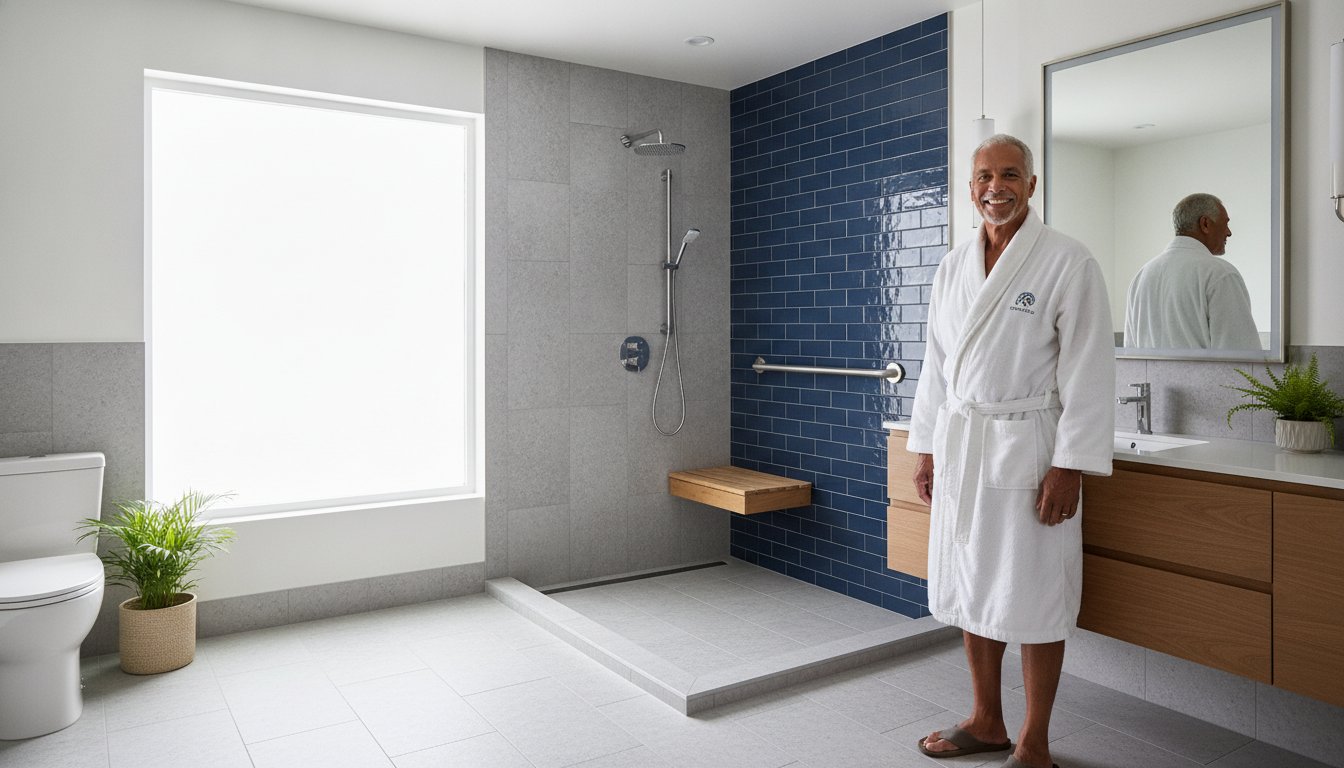

Article by
Jake Blasco, SHSS, B-2 Licensed Contractor
Jake Blasco is a Senior Home Safety Specialist® (SHSS), B-2 Licensed Residential Remodeling Contractor, and Grab Bar Specialist serving homeowners throughout Southern California. He specializes in aging-in-place modifications, grab bar installation, bathroom safety upgrades, accessibility remodeling, fall prevention solutions, and ADA-inspired home modifications. Through Blueprint Kitchen & Bath Design Studio, Jake helps seniors, veterans, and individuals with mobility challenges remain safe, independent, and comfortable in their homes. His expertise includes bathroom safety assessments, walk-in shower conversions, accessible design, railings, ramps, and other home accessibility solutions that improve quality of life while supporting long-term independence.
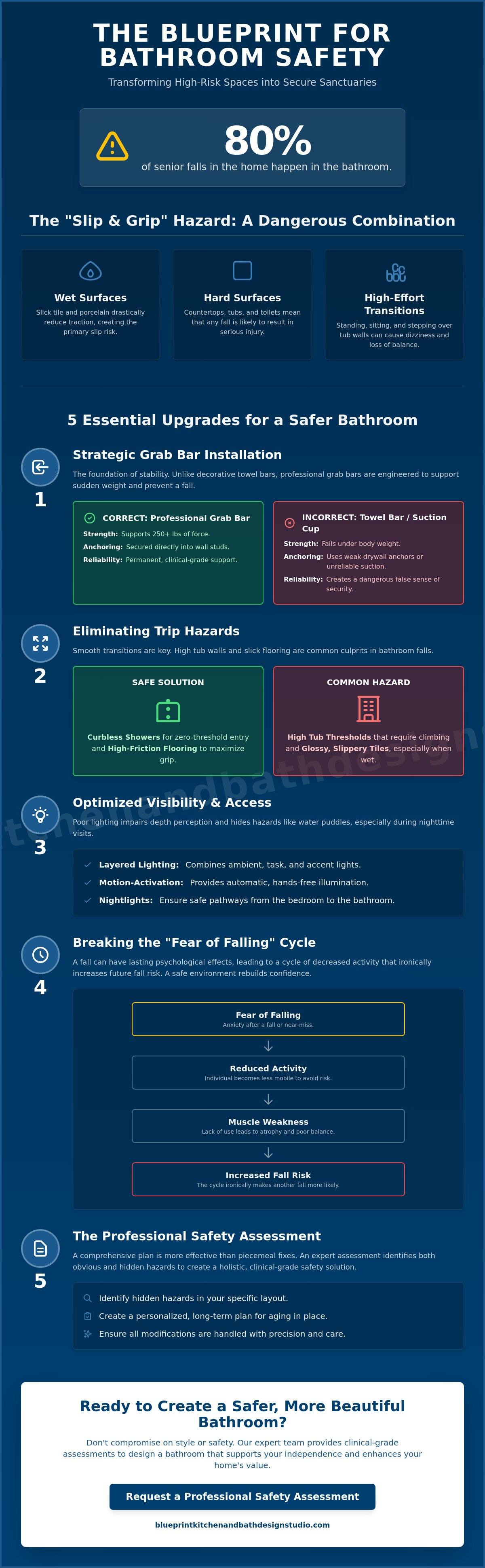
Did you know that nearly 80% of senior falls occur in the bathroom? For many, this single room represents the greatest challenge to staying independent at home. It's understandable if you feel overwhelmed by the technical standards of ADA compliance or worry about how to prevent falls in bathroom spaces without making your home feel like a clinical facility. You shouldn't have to choose between a beautiful home and a safe one.
In this article, you'll discover how to implement sophisticated, design-forward modifications that prioritize both your dignity and your safety. We'll explore five essential upgrades, including slip-resistant flooring and professional grab bar installation, that provide the highest level of protection without compromising your style. By the end, you'll have a clear plan to transform your bathroom into a secure sanctuary, along with guidance on finding a specialized expert in the Inland Empire to ensure every modification is handled with clinical precision and care.
Key Takeaways
- Identify the specific "Slip and Grip" hazards that make the bathroom a high-risk zone and learn proven strategies for how to prevent falls in bathroom spaces.
- Distinguish between decorative hardware and weight-rated, professionally anchored grab bars that provide reliable support while maintaining your home's design aesthetic.
- Explore how curbless shower installations and high-friction flooring materials eliminate dangerous thresholds and minimize slip risks.
- Understand the role of layered, motion-activated lighting in improving depth perception and ensuring safe navigation during nighttime hours.
- Discover the long-term value of a professional home safety assessment for creating a comprehensive, clinical-grade plan for aging in place.
Why the Bathroom is the Highest Fall Risk Area for Seniors
Statistically, the bathroom is the single most dangerous room in any home because it's the only space where wet surfaces and high-effort physical transitions occur simultaneously. This combination creates what specialists call the "Slip and Grip" hazard. You might find yourself losing your balance on a slick floor, only to realize there isn't a stable handhold within reach. Understanding how to prevent falls in bathroom environments starts with recognizing that standard fixtures, like towel bars or porcelain soap dishes, aren't designed to support human weight and will likely break if used for leverage.
Physical transitions also play a major role in bathroom safety. Moving from a seated position to standing, such as getting off the toilet or out of a shower chair, can trigger orthostatic hypotension. This brief moment of dizziness or lightheadedness occurs due to a sudden drop in blood pressure. In a small room filled with hard surfaces, even a momentary loss of stability can lead to a serious accident. Relying on improvised handholds during these moments of vulnerability is a common mistake that often results in injury.
To better understand these risks and how to mitigate them, watch this helpful video:
The Physical and Emotional Cost of a Fall
Research indicates that as many as 80% of senior falls in the home happen in the bathroom. For many residents in the Inland Empire, a single slip can result in a hip fracture, which is often a life-altering event that necessitates long-term care. Beyond the physical trauma, there's a significant psychological impact known as the "fear of falling" cycle. This anxiety often leads seniors to decrease their physical activity, which causes muscle atrophy and balance degradation, ironically increasing the likelihood of another fall in the future.
Identifying Hidden Hazards in Your Current Layout
Many traditional bathroom designs include subtle dangers that become more pronounced with age. High tub thresholds require you to "climb" into the shower, a movement that forces you to balance on one leg on a potentially wet surface. Inadequate lighting during late-night visits makes it difficult to judge distances or spot small puddles. Implementing comprehensive Fall prevention strategies involves more than just adding a mat; it requires addressing high-gloss tile floors and loose rugs that slide easily. Focusing on how to prevent falls in bathroom spaces means evaluating every element of the layout, from the height of the toilet to the texture of the flooring, to ensure a seamless and secure experience.
Strategic Grab Bar Installation: The Foundation of Stability
While towel bars are designed to hold the weight of a damp linen, professional grab bars are engineered to support 250 pounds or more of sudden force. This distinction is vital when considering how to prevent falls in bathroom environments. Many accidents occur when a senior instinctively reaches for a towel rack or soap dish during a slip, only for the fixture to pull away from the wall. Real safety requires weight-rated hardware that integrates seamlessly with your existing decor. Today's "designer" grab bars offer the same clinical strength as hospital-grade versions but feature high-end finishes like matte black or brushed nickel to complement a luxury aesthetic.
Professional installation ensures these bars are anchored directly into structural wall studs. Using drywall anchors or toggles is insufficient for the high-impact load of a fall. Similarly, suction-cup bars provide a dangerous false sense of security; they are prone to losing their vacuum seal without warning. The National Institute on Aging recommends using permanent fixtures that are securely bolted to the wall to ensure they remain reliable over time. When these bars are installed with precision, they become a permanent part of the home's structure rather than a temporary fix.
Optimal Placement: ADA Standards vs. Personalized Comfort
ADA guidelines provide a helpful baseline, but true safety is personalized to your specific height and reach. For example, a horizontal bar next to the toilet should be placed at a height that allows for easy leverage when standing. Vertical bars can assist with balance during the initial step into a tub. For more technical specifications on positioning, you can review our guide on Professional Grab Bar Installation in Redlands, CA. This tailored approach ensures that every point of contact feels natural and secure.
The "Two-Point Contact" Rule for Shower Entry
Safe shower entry requires a "two-point contact" strategy. This means having a stable handhold both outside the shower threshold and inside the bathing area. This setup is critical during the transition from a dry floor to a wet one, where traction is most unpredictable. If you use a shower bench, bars should be positioned to assist with the lowering and lifting motion. If you're unsure where to begin, a professional home safety assessment can help identify the exact points where your movement needs the most support as you learn how to prevent falls in bathroom spaces.
Eliminating Trip Hazards: Flooring and Entryway Solutions
While grab bars provide the necessary handholds discussed earlier, the ground beneath your feet remains the primary point of contact. To address how to prevent falls in bathroom settings effectively, we must look at the "tub dam," which is that traditional four-to-six-inch barrier you have to step over to enter a shower. For a senior with limited hip mobility, this barrier is the most common trip hazard in the house. Eliminating this threshold is a critical step in creating a space that supports long-term independence and physical autonomy.
Professional designers use a metric called the Coefficient of Friction (COF) to measure slip resistance. A COF of 0.42 or higher is generally the standard for wet residential floors. Unlike temporary "non-slip" stickers or adhesive strips that peel over time and collect bacteria, permanent slip-resistant flooring provides a consistent texture integrated into the material itself. Experts at UChicago Medicine highlight that removing obstacles and securing surfaces are foundational steps for home safety. By choosing materials with high COF ratings, you create a floor that grips even when soapy water is present.
The Move Toward Curbless Shower Design
A curbless shower, often called a roll-in shower, eliminates the threshold entirely. This creates a seamless transition from the main bathroom floor into the bathing area. It's the gold standard for aging in place because it removes the need to balance on one leg while stepping over a ledge. Beyond the clinical benefits, it offers a sophisticated, modern aesthetic that makes small bathrooms feel significantly larger. It also ensures the space is prepared for future needs, such as wheelchair or walker access, without requiring a second, costly remodel later on.
Permanent Slip-Resistant Flooring Materials
Choosing the right material is a balance of science and style. Small-format mosaic tiles are a popular choice because the frequent grout lines act as natural "tread" for your feet. If you prefer larger tiles, look for specialized non-slip porcelain with a matte or honed finish. Polished surfaces should be avoided in wet environments because they become dangerously slick with even a small amount of moisture. A practical tip for testing how to prevent falls in bathroom environments is to wet a sample tile and try to slide your hand across it; if it feels like glass, it isn't a safe choice for your renovation.
Optimizing Visibility and Access for Nighttime Safety
Navigating a bathroom at 2:00 AM requires more than just a simple nightlight. As we age, our eyes require more time to adjust to light changes, and our depth perception can become less reliable. Implementing layered lighting is a sophisticated way to eliminate deep shadows that might hide a puddle or a rug's edge. By combining ambient overhead lights with focused task lighting, you'll ensure every corner of the room is visible. This strategy is a primary component of how to prevent falls in bathroom environments, especially when balance is already compromised by the physical transitions discussed earlier.
Traditional toggle switches can be difficult to manipulate for those with arthritis or limited fine motor skills. Replacing these with rocker-style switches provides a larger surface area that can be operated with a palm or even an elbow. These switches often include an internal glow, making them easy to locate in the dark without fumbling. Small, functional changes like these reduce the cognitive load and physical effort required for simple daily routines, allowing you to focus on your movement rather than the hardware.
Automated Lighting Systems for Seniors
Automated lighting removes the need to search for a switch entirely. Toe-kick lighting, which consists of LED strips installed under the vanity or along the baseboards, provides a soft glow that illuminates the floor path without causing glare. This low-level light is particularly helpful for maintaining a safe path to the toilet. Motion-activated sensors ensure the lights turn on the moment you enter the room, providing immediate clarity. For those living with dementia, consistent and automatic lighting reduces cognitive load by removing the confusion of navigating a dark, unfamiliar-looking space.
Widening Access: Doorways and Clear Floor Space
Many historic homes in the Inland Empire, particularly those in Redlands, were built with narrow 24-inch or 28-inch bathroom doorways. These dimensions are often too tight for a walker or wheelchair to pass through comfortably, creating a bottleneck that increases the risk of a stumble. If a full remodel isn't immediately possible, "swing-clear" hinges are a low-cost alternative that can add nearly two inches of clearance by moving the door entirely out of the opening.
True accessibility requires enough clear floor space for a 5-foot turning radius, which allows a wheelchair to rotate 360 degrees without hitting a wall or fixture. Ensuring this level of maneuverability is essential for maintaining dignity and ease of movement. If your current layout feels restrictive, exploring professional doorway widening and accessibility services can provide the structural freedom you need for long-term independence. These modifications ensure that your home remains a supportive environment regardless of how your mobility needs change over time.
Designing for Independence: The Professional Safety Assessment
While the previous sections provide a foundation for how to prevent falls in bathroom spaces, every home has unique structural challenges that a standard checklist might miss. A DIY walk-through is a helpful start, but it often overlooks technical details like wall stud placement, plumbing interference, or the specific weight-bearing capacity of existing surfaces. A professional assessment provides a clinical-grade review of your environment. This process ensures that every modification you choose is both structurally sound and perfectly tailored to your daily movements.
Working with a Senior Home Safety Specialist (SHSS) adds a layer of expertise that general contractors often lack. This designation means the professional understands the intersection of aging physiology and home design. Blueprint Kitchen and Bath Design Studio integrates this specialized knowledge into our high-end remodeling projects across Redlands, Loma Linda, and Yucaipa. We believe that safety shouldn't come at the expense of style. Our goal is to transform your bathroom into a space that feels like a luxury retreat while functioning with the precision of a medical-grade facility.
What to Expect During a Home Safety Consultation
A professional consultation is a comprehensive evaluation of your home’s current state and your future needs. Specialists check for wall strength to ensure grab bars won't pull away under pressure and identify plumbing lines to avoid accidental damage during installation. You can preview the depth of this evaluation by reviewing our Bathroom Safety Assessment Home Checklist. Each consultation results in a customized safety plan. This plan accounts for your specific mobility levels, ensuring that every bar, light, and floor tile is positioned for maximum utility and comfort.
Investing in Peace of Mind for the Inland Empire
Proactive home modification is an investment in your long-term autonomy and financial well-being. When you consider the significant costs associated with assisted living facilities or emergency hospital stays, the value of a safe home becomes clear. Beyond the numbers, there's an immeasurable sense of dignity in remaining in your own home. By creating a space that's both beautiful and secure, you eliminate the fear of a life-altering accident. You deserve to move through your home with confidence and ease. If you're ready to secure your home and protect your independence, schedule a professional bathroom safety assessment today to begin your journey toward a safer lifestyle and learn more about how to prevent falls in bathroom environments.
Secure Your Future Independence
Creating a safe bathroom is about more than just hardware; it's about preserving your dignity and physical autonomy. By addressing high-risk areas with weight-rated grab bars, curbless shower entries, and automated lighting, you transform a hazardous room into a supportive sanctuary. Learning how to prevent falls in bathroom environments allows you to stay in the home you love while maintaining the highest standards of safety and style.
As SHSS Certified Senior Home Safety and Grab Bar Specialists, we focus on aging-in-place remodeling and ADA compliance that feels like a natural extension of your home's design. We serve homeowners in Redlands, Yucaipa, and throughout the Inland Empire, ensuring every modification is handled with clinical precision. You don't have to navigate these transitions alone. When you're ready to move from planning to action, we're here to provide the expertise you need for a worry-free lifestyle.
Request Your Professional Bathroom Safety Assessment today to start your journey toward a more secure and beautiful living space.
Frequently Asked Questions
Is it possible to install grab bars without making my bathroom look like a hospital?
Yes, modern safety hardware is designed to blend seamlessly with high-end interior aesthetics. You can choose from "designer" grab bars that feature sophisticated finishes like matte black, brushed gold, or polished chrome. These fixtures look identical to luxury towel bars but provide the weight-rated structural support necessary to ensure your safety and independence.
What is the best height for a shower grab bar?
Standard horizontal grab bars are typically installed between 33 and 36 inches from the shower floor. However, a specialized installer will often personalize this height based on your specific stature and reach. Vertical bars are often placed near the shower entry to provide a stable handhold while you transition between different floor surfaces and moisture levels.
Can I install grab bars myself using a DIY kit?
While DIY kits are available, professional installation is strongly recommended to ensure the bars are anchored directly into structural wall studs. Drywall anchors and suction-cup devices often fail under the sudden force of a fall, creating a dangerous false sense of security. Professional installation is a critical step in how to prevent falls in bathroom environments because it guarantees the hardware can support 250 pounds or more of sudden weight.
How much does a typical bathroom safety upgrade cost in Redlands?
The cost of a safety upgrade varies depending on the number of fixtures, the material of your walls, and the complexity of the structural reinforcement required. Factors such as whether you are installing simple grab bars or performing a full curbless shower conversion will influence the final investment. A professional home safety assessment can help you determine which modifications fit your specific needs and budget.
What is a curbless shower and is it really safer for seniors?
A curbless shower is a design where the bathroom floor continues into the shower area without a raised threshold or "lip." This eliminates the need to step over a high tub dam, which is the primary trip hazard in most bathrooms. It's significantly safer for seniors because it allows for a smooth transition and provides ample space for future mobility aids like walkers or wheelchairs.
Does Medicare or insurance cover the cost of bathroom grab bar installation?
Traditional Medicare generally classifies grab bars as "convenience items" rather than durable medical equipment, so they typically aren't covered. However, some Medicare Advantage plans or long-term care insurance policies may offer partial reimbursement for home safety modifications. It's always best to consult with your specific insurance provider to see if you qualify for any financial assistance or tax incentives for aging-in-place upgrades.
How long does it take to complete a senior-friendly bathroom modification?
Small-scale modifications, such as professional grab bar installation, can often be completed in a single afternoon. More extensive projects, like installing slip-resistant flooring or converting a traditional tub to a walk-in shower, typically take several days to a week. A specialized contractor will provide a clear timeline during your initial consultation to ensure your daily routine is minimally disrupted.
What should I look for in a certified senior home safety specialist?
You should look for a professional who holds a Senior Home Safety Specialist (SHSS) designation. This certification ensures the specialist has been trained to identify specific environmental risks and understands how to prevent falls in bathroom areas through clinical-grade modifications. They should also have a strong portfolio of local work in the Inland Empire and a deep understanding of both ADA standards and residential design aesthetics.


