


Article by
Jake Blasco, SHSS, B-2 Licensed Contractor
Jake Blasco is the kitchen, bath, and accessibility specialist behind Blueprint Kitchen & Bath Design Studio. He helps homeowners create beautiful, functional spaces through thoughtful planning, practical design, and careful project coordination. His background in commercial production and set construction brings a strong eye for detail, organization, and finish quality to every project. Jake is a certified Senior Home Safety Specialist® and Grab Bar Specialist, allowing him to integrate aging-in-place and home-safety features without sacrificing style. He serves Huntington Beach, Orange County, and surrounding Southern California communities.
What if making your parent’s home safer doesn’t require changing everything familiar? If you’re concerned about dementia-related safety at home in Redlands, you’re likely balancing two real concerns: reducing everyday hazards and avoiding changes that could feel confusing or upsetting. The goal isn’t to remove every risk at once. It’s to understand how your parent uses each space and make thoughtful adjustments that preserve comfort, choice, and dignity.
A calm, room-by-room review can help you spot practical concerns during familiar routines, from moving between rooms to preparing a meal or bathing. It can also help distinguish simple changes, such as improving lighting or clearing a walkway, from larger design questions that may need professional input.
This checklist will guide you through key areas of the home, suggest ways to keep spaces recognizable, and help you prioritize next steps. You’ll also learn when features such as grab bars, slip-resistant flooring, or a curbless shower may be worth discussing as part of a broader home-safety plan, not a substitute for ongoing care.
Key Takeaways
- Start by observing familiar routines and asking how each space supports your parent’s comfort and independence.
- Trace everyday paths, such as the bedroom-to-bathroom route, and note lighting, clutter, loose rugs, or obstacles that may need attention.
- Use the checklist for making home safe for parent with dementia Redlands to identify concerns, then separate simple household adjustments from changes that need professional guidance.
- Remember that a grab bar or other safety feature may support a specific task, but it can’t replace individualized care or supervision.
- Prioritize possible updates around your parent’s routines and explore accessible design options with a qualified remodeling professional when needed.
Making a Redlands Home Safer for a Parent With Dementia Starts With Familiar Routines
Start by observing how your parent moves through familiar routines, then consider the home from their point of view. A dementia-aware safety review checks rooms against everyday activities, such as getting out of bed, finding the bathroom, and preparing a meal. The aim is to notice where a routine feels difficult and consider whether the space is contributing, not to assume every unfamiliar action calls for a renovation.
Needs vary from person to person and can change over time, so no checklist can guarantee safety or prevent every incident. A helpful starting point for families searching “making home safe for parent with dementia Redlands” is to record specific observations and involve the parent in decisions whenever possible. For a general introduction to how dementia may affect people differently, see this overview of understanding dementia.
For another perspective on reviewing a familiar home, watch this video from Dementia Careblazers:
Notice where everyday routines feel difficult
Pay attention to transitions: getting up, walking to the bathroom, moving between the kitchen and dining area, or locating something used every day. Note the location, time, and activity when a problem occurs. “The hallway feels confusing on the way to the bathroom at night” gives you more useful information than a general conclusion that the home is unsafe.
Invite your parent’s perspective with calm, simple questions, such as, “Is this path easy to see?” or “Would it help if we moved this?” If they don’t want to discuss a change, pause and try another time. A conversation works best when it feels collaborative rather than corrective.
Keep safety changes compatible with familiarity
Familiar surroundings can support a sense of ease. Avoid moving many objects or changing several rooms at once. Instead, look at one specific difficulty and consider whether lighting, contrast, or visual clutter could be affecting recognition in that space. A clear route or a more visible everyday item may make a familiar activity easier without making the home feel unfamiliar.
Describe possible adjustments in terms of what your parent wants to keep doing, such as reaching the bathroom more comfortably or continuing to help prepare meals. These observations create a practical basis for the room-by-room checklist ahead, while leaving room for individual needs and professional guidance where a design change may be involved.
A Room-by-Room Dementia Home-Safety Checklist for Redlands Families
Follow your parent’s usual routes through the home rather than inspecting each room in isolation. A bedroom-to-bathroom path, for example, includes the bedroom, hallway, doorway, and bathroom entrance. Walk these routes as your parent would, at the times they use them, and note what could make the next step harder to see or navigate. This practical approach helps families making home safe for parent with dementia Redlands focus on specific concerns instead of changing rooms without a clear reason.
- Bedroom, hallway, and entrances: Check night-time routes for clear floors, usable lighting, loose rugs, and objects that narrow the path. Notice whether familiar doors and destinations are easy to recognize. Record steps or raised thresholds for possible professional review.
- Bathroom: Follow the usual sequence for entering, toileting, washing hands, bathing, and standing or sitting. Look at the entry, flooring, support needs, and how the parent moves between fixtures. Pay attention to surfaces that may become slippery when wet.
- Kitchen and dining area: Observe the route between food preparation and the table. Check whether commonly used dishes, utensils, and ingredients are visible and easy to reach, and whether clutter interrupts the work area or walking path.
Check bedrooms, hallways, and entrances
Consider what the route looks like in the evening or at night, not only in daylight. A clear floor and familiar visual cues may help make the destination easier to identify. Keep frequently used paths open, and note where a doorway feels difficult to use. Don’t assume every threshold needs alteration; document the concern and seek an accessibility review if a change may involve the home’s structure or layout.
Review bathrooms and kitchens through daily tasks
In the bathroom, consider whether the parent can follow their customary routine without an awkward reach or difficult transition. If bathing or moving around the room raises concerns, see Blueprint’s Redlands bathroom safety upgrades guide for more focused planning ideas.
In the kitchen, look at the items your parent uses most and the space needed to prepare and serve food. Avoid relocating familiar objects without considering how the change may affect recognition. Grab bars, slip-resistant flooring, or a layout adjustment may be worth discussing, but first assess the room and the task the feature is meant to support. For changes beyond simple household adjustments, a design or construction professional can help evaluate the space. That keeps the checklist grounded in your parent’s actual routines rather than a one-size-fits-all plan.
Dementia Home Safety Is More Than Grab Bars: Balance Risk, Comfort, and Independence
A grab bar or other home-safety feature can address a specific physical challenge, but it can’t resolve every concern related to dementia. A person may have difficulty recognizing a room, following a familiar sequence, or responding to an unexpected change. A modification should be one part of a broader safety plan, not a substitute for individualized care or supervision.
Keep this principle in view: Match each proposed change to an observed task and the specific concern it’s meant to address. If a change doesn’t connect to something you’ve noticed, pause and consider whether it could disrupt a familiar routine without offering a clear benefit.
When a home modification may help
A grab bar may provide support during a particular movement, such as sitting down or standing up, when its placement suits the person and the room. A curbless shower or slip-resistant flooring may also be considered, but each depends on the existing space, surfaces, and how the parent uses the room. These are design decisions, not automatic fixes.
Seek assessment from a qualified design or construction professional when a proposed update involves walls, plumbing, doorway dimensions, or other structural work. The home’s conditions affect what changes are suitable, and permit or code requirements can vary by city. Confirm what applies in Redlands before beginning work.
When a design change may not be enough
Remodeling doesn’t diagnose dementia or provide hands-on care. A physical feature may support one activity, but it can’t address every change in memory, judgment, or daily support needs. It also can’t ensure that a person will avoid falls or remain independent. Be cautious of any single modification presented as a complete solution.
Consider the trade-off between a potential benefit and the disruption a change could cause. Moving familiar objects, adding labels, or altering a well-known layout may help in one situation but create confusion in another. Make changes thoughtfully, involve your parent where possible, and observe how the adjustment feels in daily use before deciding what else to change.
Families searching for “making home safe for parent with dementia Redlands” can use this distinction to guide next steps: record the task, describe the concern, and discuss changes with the appropriate professional. If safety or support needs are changing, talk with the parent’s healthcare team as well. Home design can make an activity easier to navigate, while care guidance helps address needs that remodeling alone cannot meet.
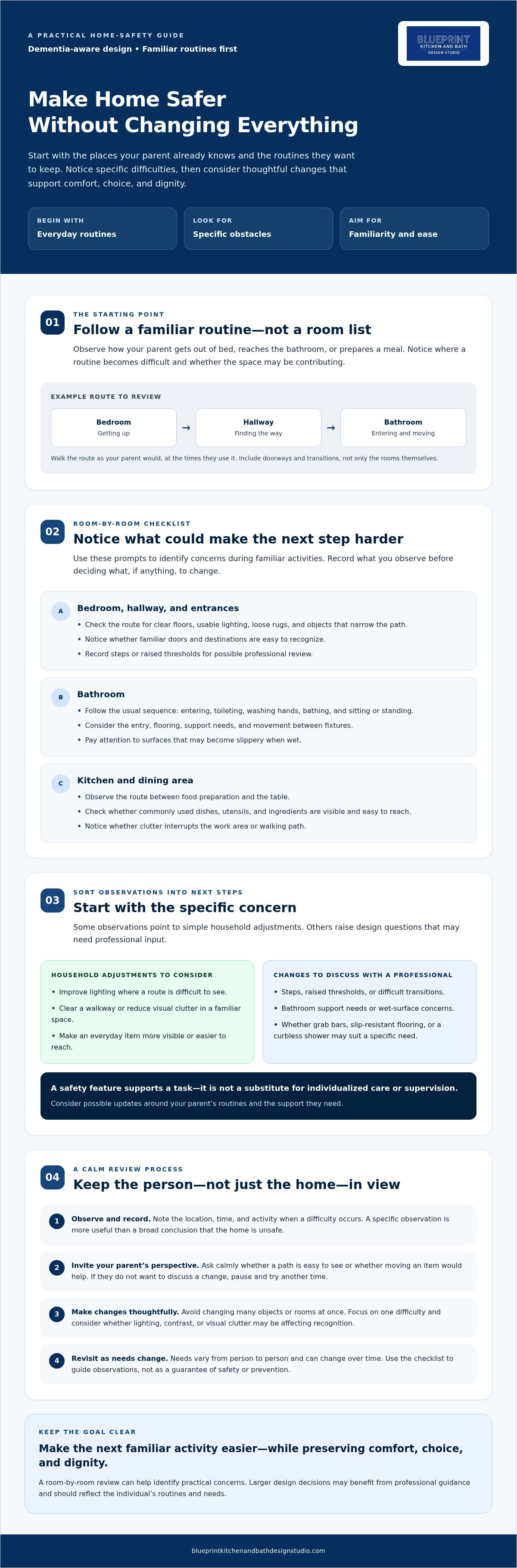
How to Use the Checklist and Prioritize Home-Safety Changes
Turn your observations into a short, workable plan rather than treating the checklist as a whole-home renovation brief. A useful sequence is: observe the task, document what happened, discuss it with your parent and relevant family members, choose priorities, then assess possible changes. This keeps decisions connected to daily life and makes it easier to distinguish a simple adjustment from a project that needs design or construction guidance.
Make a useful observation list
For each concern, note the activity, location, and conditions that may have affected it. For example, record whether a path seemed difficult to use at night, whether an item was hard to find, or whether a doorway felt awkward to pass through. Ask family members or caregivers to share what they’ve noticed, but label each entry as an observation or question rather than treating an assumption as fact.
Then choose a manageable priority or two. A long list can feel overwhelming, and changing several areas at once may disrupt familiar routines. After a small adjustment, pay attention to whether it makes the activity easier or creates new confusion. That response can help guide the next decision.
Know when to seek local remodeling guidance
Household adjustments may be straightforward, but changes to layout, access, surfaces, walls, plumbing, or doorway dimensions call for careful assessment. A design professional can review how the space is used and discuss which remodeling options may fit the home. For broader planning, see the Redlands aging-in-place remodeling guide.
Before work begins, verify the permit and code requirements that apply to the specific project in Redlands. Requirements can vary by city and by the work involved. Planning also means considering your parent’s preferences, household logistics, material selections, project scope, permitting, and trade availability. These details can affect how a change is designed and scheduled, so avoid assuming that every update follows the same process.
For families making home safe for parent with dementia Redlands, a thoughtful plan respects both the concern and the person who lives with it. If a potential update involves remodeling or accessible design, contact Blueprint Kitchen and Bath Design Studio at 909-679-3296 or email the design studio to discuss the home’s needs.
Planning Dementia-Friendly Home Updates With a Redlands Design Professional
A remodeling conversation can help turn home-safety observations into design questions: Does the bathroom layout make a familiar routine difficult? Would a doorway change improve access? Could flooring or a shower update better support how the space is used? Blueprint Kitchen and Bath Design Studio serves Redlands with remodeling and design services that include aging-in-place updates, grab bars, curbless showers, doorway widening, and slip-resistant flooring.
Jake Blasco may be identified as a Senior Home Safety Specialist® and Grab Bar Specialist. That background is relevant to home-safety and design discussions, but it doesn’t replace medical advice, caregiving, or individualized clinical guidance. A remodeling professional can help consider the home’s layout and potential design changes, while the parent’s healthcare team can address questions about health and care needs.
What to discuss during a home design conversation
Bring your observation notes, a description of familiar routines, and your parent’s preferences. Be specific about the task and location, then discuss whether the concern might relate to grab bars, shower access, flooring, doorways, or the broader layout. Ask how an update could fit the home’s existing design and preserve spaces your parent recognizes. For focused information about this support feature, review the guide to professional grab bar installation in Redlands.
Good planning considers the actual space, not just a feature in isolation. Existing conditions can affect which design options are suitable. If a project involves structural changes, plumbing, or altered doorway dimensions, ask what details need review before work proceeds and verify applicable Redlands permit and code requirements. Requirements can vary by city and project.
Choose a next step without rushing the decision
Separate design questions from care questions. A professional remodeler can discuss physical changes to the home, but concerns about diagnosis, changing symptoms, or the level of hands-on support belong with the appropriate healthcare or care professionals. There’s no need to decide on every possible update during one conversation.
Project planning also depends on scope, materials, site conditions, selections, permits, and trade availability. These factors shape decisions and scheduling, so avoid relying on a fixed timeline before the project is understood. A measured discussion can help you identify which design options are worth exploring while keeping your parent’s comfort and routines in view.
If you’re considering making home safe for parent with dementia Redlands, contact Blueprint Kitchen and Bath Design Studio to discuss remodeling or design options. Call 909-679-3296 or email [email protected].
Take the Next Step at Your Own Pace
A thoughtful home-safety plan begins with your parent’s familiar routines. Use the checklist to record specific concerns, consider one change at a time, and weigh practical benefits against the comfort of recognizable surroundings. A grab bar or layout update may support a particular task, but remodeling is only one part of a broader plan and doesn’t replace care or medical guidance.
For families considering making home safe for parent with dementia Redlands, Blueprint Kitchen and Bath Design Studio offers aging-in-place remodeling and home-safety upgrades. The business identifies as a SHSS Certified Senior Home Safety & Grab Bar Specialist. A design conversation can help you explore whether changes to a bathroom, doorway, flooring, or other part of the home may fit your parent’s needs and preferences. Project scope, materials, site conditions, selections, permits, and trade availability all influence planning.
To discuss remodeling or design options, contact Blueprint Kitchen and Bath Design Studio or call 909-679-3296. A measured first step can help you support familiar routines while keeping your parent’s dignity and comfort at the center.
Frequently Asked Questions
How do I make a home safer for a parent with dementia?
Start by observing familiar routines and noting where a specific task becomes difficult. Follow everyday paths, such as the route from the bedroom to the bathroom, and check for loose rugs, clutter, dim areas, or blocked walkways. Ask your parent what feels confusing or uncomfortable, and make changes gradually. A room-by-room review can help families making home safe for parent with dementia Redlands identify concerns without assuming every room needs remodeling.
What should I check first when dementia makes home routines more difficult?
Check the particular routine that has become challenging, including where and when it happens. For example, observe whether the path to the bathroom is clear and recognizable at night, or whether kitchen items are easy to find during meal preparation. Record what you see rather than drawing broad conclusions. If the concern involves health, changing symptoms, or the level of support needed, discuss it with the parent’s healthcare team.
Can changing furniture or room layouts confuse a person with dementia?
It can. Moving familiar furniture, household objects, or visual cues may make a known space harder to recognize, though each person responds differently. Before changing a room, consider whether the adjustment addresses a specific observed concern. Make one change at a time when practical, explain it calmly, and notice how your parent responds during familiar routines. If a change seems to create distress or confusion, pause and reassess with appropriate support.
Are grab bars enough to make a bathroom safer for someone with dementia?
No. A grab bar may provide support during a particular movement, but it doesn’t address every bathroom concern or replace individualized care and supervision. Consider the full routine, including entering the room, bathing, toileting, and moving between surfaces. The bathroom layout and the person’s needs matter when considering grab bars, flooring, or shower access. A design professional can discuss home modifications, while health and care questions belong with the appropriate professionals.
When should I consider home modifications for a parent with dementia?
Consider discussing modifications when you’ve observed a recurring difficulty with a specific activity, such as using a shower, moving through a doorway, or reaching commonly used items. First document the task and concern, then discuss possible next steps with your parent and relevant professionals. A design review may help clarify options for grab bars, slip-resistant flooring, doorway widening, or other remodeling. Changes should be chosen thoughtfully, not as a guarantee against incidents.
Do I need a permit for home modifications in Redlands, California?
Permit needs depend on the work, so verify requirements for the specific project with the City of Redlands Building & Safety Division before starting. Work involving structural changes, plumbing, or electrical systems may have different requirements from cosmetic updates. Don’t assume a project is exempt based on its size or description. If the home is in another city, check with that city’s building department, since permit and code requirements can vary by location.
Can a remodeling professional assess a home for dementia-related safety concerns?
A remodeling professional can review relevant layout and accessibility considerations and discuss potential home updates, but doesn’t diagnose dementia or provide medical care. Blueprint Kitchen and Bath Design Studio identifies as a SHSS Certified Senior Home Safety & Grab Bar Specialist and offers aging-in-place remodeling and home-safety upgrades. The company serves Redlands, Beaumont, Huntington Beach, Newport Beach, Costa Mesa, Fountain Valley, Seal Beach, Westminster, Los Alamitos, Long Beach, and Irvine.
Disclaimer
This article provides general educational information and design inspiration, not project-specific professional advice. Costs, timelines, permit requirements, building codes, and product suitability vary by property and jurisdiction. Final scope, pricing, and specifications are established only through a written proposal or contract. Consult qualified professionals and local building officials before beginning work. Unless expressly identified as a completed Blueprint project, images are illustrative and may include stock photography, design renderings, or AI-generated imagery.


