

Article by
Jake Blasco, SHSS, B-2 Licensed Contractor
Jake Blasco is the kitchen, bath, and accessibility specialist behind Blueprint Kitchen & Bath Design Studio. He helps homeowners create beautiful, functional spaces through thoughtful planning, practical design, and careful project coordination. His background in commercial production and set construction brings a strong eye for detail, organization, and finish quality to every project. Jake is a certified Senior Home Safety Specialist® and Grab Bar Specialist, allowing him to integrate aging-in-place and home-safety features without sacrificing style. He serves Huntington Beach, Orange County, and surrounding Southern California communities.
What if the most important safety feature in your home was also the one that caused the most anxiety during installation? You want the security of a fall-proof bathroom, but the fear of drilling into expensive tile or creating an institutional aesthetic often leads to hesitation. It's a common concern for homeowners who value both their independence and their home's design. Understanding proper shower grab bar placement is the bridge between these two goals. It ensures your bathroom remains a sanctuary of comfort while providing the structural support you need to move with confidence.
In this guide, you'll master the technical requirements and personalized strategies needed to achieve professional results. We'll explore the current 2026 safety standards, including the gold-standard ADA heights of 33 to 36 inches, and how to adapt these for your specific physical proportions. You'll learn where to position bars for entry, exit, and stability during use, turning a complex renovation task into a clear, manageable plan. From selecting hardware that complements your decor to ensuring a load capacity that meets or exceeds 250 pounds, we provide the expertise you need for a safer, more accessible home.
What You Will Master:
- The distinction between rigid ADA standards and the flexible, ergonomic customization required for residential safety.
- How to secure the three essential zones for shower grab bar placement, providing a continuous path of support from the threshold to the showerhead.
- The science of the "Elbow Height Rule" and how to calculate the most natural grip points for maximum physical leverage.
- Specialized positioning strategies for shower benches and chairs to manage the high-risk transition from sitting to standing.
- Crucial technical requirements for structural integrity, including why professional stud-mounting is mandatory and why suction-cup bars remain a significant safety hazard.
By the end of this guide, you will have a professional framework for creating a bathroom that prioritizes both your long-term independence and your home’s modern aesthetic.
ADA vs. Residential Shower Grab Bar Placement Standards
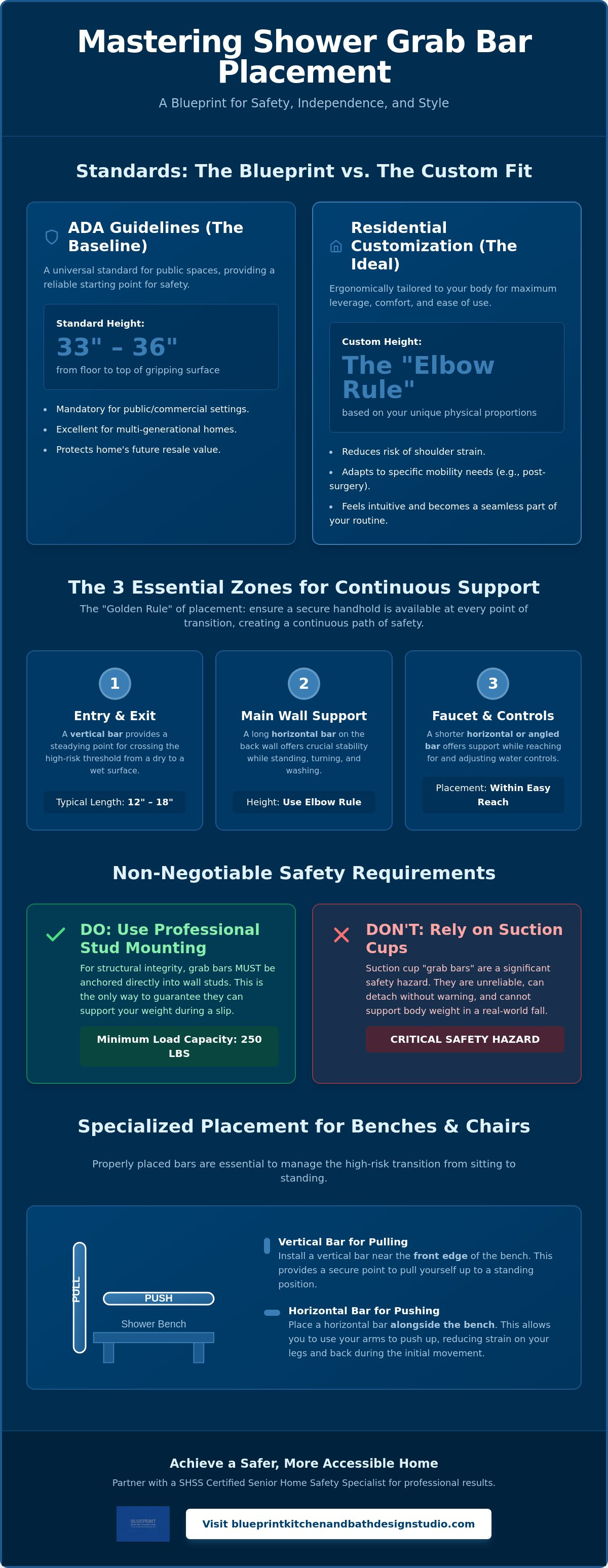
The Americans with Disabilities Act (ADA) established the 2010 Standards for Accessible Design to ensure public spaces remain navigable for everyone. These regulations dictate that Grab Bars must be installed between 33 and 36 inches from the floor to the top of the gripping surface. In a commercial setting, these rules are law. In your home, however, they serve as a reliable baseline rather than a strict requirement. Choosing the right shower grab bar placement involves balancing these proven safety metrics with your personal physical proportions.
While ADA guidelines provide a sense of organized reliability, residential projects offer the luxury of ergonomic customization. A professional assessment often reveals that a user's natural reach doesn't align perfectly with a standardized 34-inch height. By adjusting the installation to match your specific height and arm length, you reduce the risk of shoulder strain and ensure your grip is always secure. Partnering with a SHSS Certified Senior Home Safety Specialist allows you to bridge the gap between clinical necessity and domestic comfort. These experts evaluate your mobility patterns to create a layout that feels intuitive rather than institutional.
When to Follow ADA Guidelines at Home
There are practical reasons to stick closely to federal standards during a home modification. If you live in a multi-generational household, ADA heights provide a functional middle ground that works for most adults. Following these universal design principles also protects your home's resale value. Future buyers will recognize the standardized accessibility, making the property more attractive to a broader demographic. Using ADA as a starting point ensures your bathroom meets a high level of professional thoroughness from the day of installation.
The Flexibility of Residential Customization
The primary benefit of residential safety design is its ability to adapt to your lifestyle. Shorter individuals or those with limited range of motion may find that a slightly lower bar provides better leverage. Conversely, taller users often require higher placement to maintain their balance without stooping. This customization is particularly vital for those recovering from hip or knee replacements, where specific angles of support are needed to manage weight distribution. Tailoring your shower grab bar placement to these personal needs transforms a safety feature into a seamless part of your daily routine, fostering long-term independence and peace of mind.
The Three Essential Zones for Shower Grab Bar Placement
Effective shower grab bar placement follows a simple but vital principle: a secure handhold must be available at every point of transition. This "Golden Rule" ensures that from the moment you step onto the wet floor until you exit the space, your center of gravity is always supported. To achieve this level of professional thoroughness, we divide the shower into three essential zones. Each zone addresses a specific movement, turning a potentially hazardous environment into a predictable, safe space for independent living.
By mapping out these zones before drilling into your tile, you create a continuous path of stability. This methodical approach removes the guesswork and ensures that the hardware serves your physical needs without compromising the aesthetic of your home. If you are planning a more comprehensive update, a professional approach to aging-in-place remodeling can help integrate these zones into a seamless, high-end design.
Zone 1: Entry and Exit Stability
The threshold is the most high-risk area of the bathroom. Crossing from a dry, level floor to a wet, potentially sloped surface requires a shift in balance that can lead to slips. To secure this transition, a vertical grab bar should be installed on the entry jamb or the outer wall. This bar provides a steadying point for the non-dominant hand while the body steps into the shower. Typically, these entry bars are 12 to 18 inches in length. This size offers a sufficient gripping surface for users of various heights without overwhelming the visual space of the entryway. It provides the initial leverage needed to move confidently into the next zone.
Zone 2 & 3: Movement and Task Support
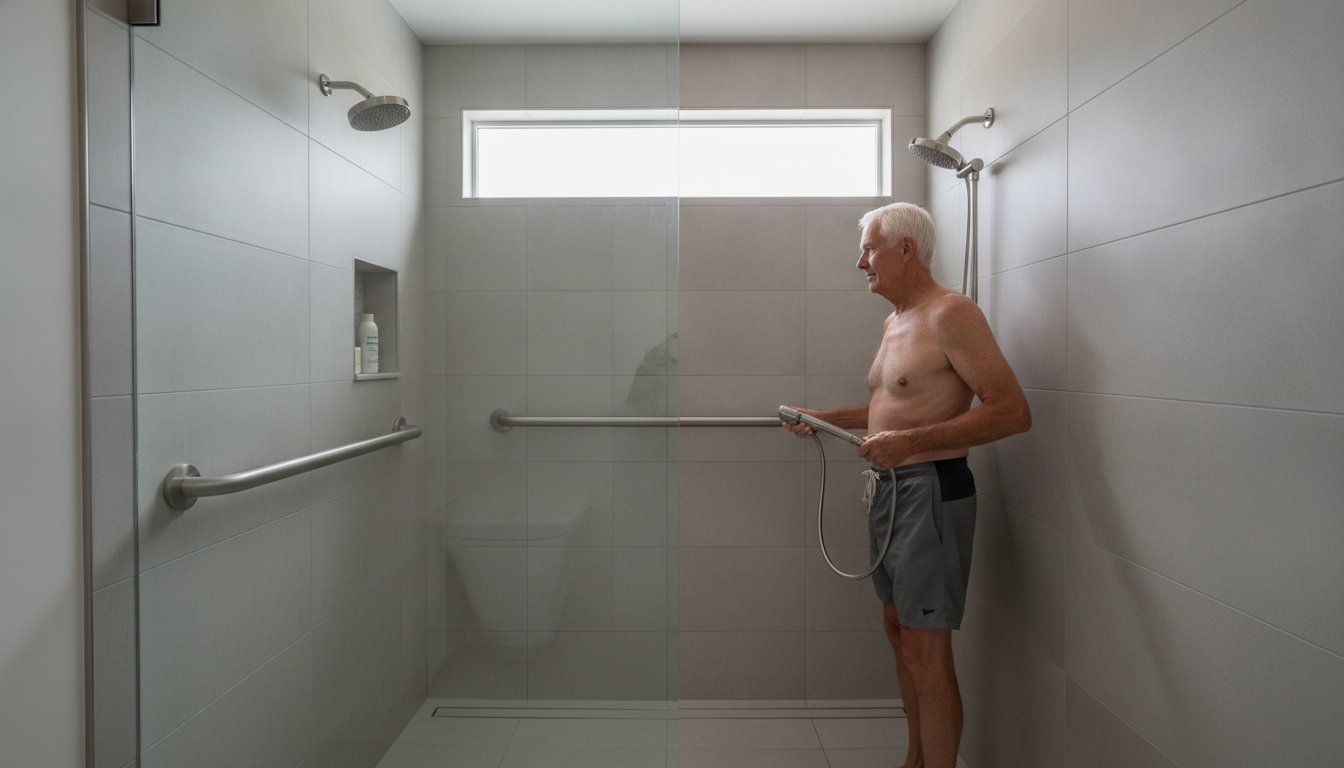
Once inside, Zone 2 focuses on the side wall. This area requires a horizontal bar that runs along the length of the shower. This modification allows you to maintain balance while washing or moving toward the controls. It serves as a rail that guides your movement, providing a constant sense of security. Zone 3 covers the control wall, where you reach for faucets and showerheads. This is a critical moment of vulnerability because reaching often shifts your weight onto your toes or one foot. We recommend a vertical or L-shaped bar in this zone to provide a natural grip point while you adjust water temperature or handle a handheld sprayer.
A common mistake in many homes is the "faucet grab," where users reach for the shower handle or the temperature control for balance. These fixtures are not designed to support human weight and can easily break away from the wall, leading to a catastrophic fall. Dedicated grab bars in Zone 3 eliminate this risk. By placing a vertical bar near the controls, you ensure that your hand naturally finds a load-rated support instead of a fragile plumbing fixture. This strategic placement prioritizes your long-term well-being and physical autonomy during every wash.
Calculating the Ideal Height and Angle for Maximum Leverage
While standard guidelines suggest a height of 33 to 36 inches, true safety depends on the physics of leverage. Horizontal bars are excellent for steadying yourself, but they aren't always the most efficient for every movement. Effective shower grab bar placement requires an understanding of how your body naturally reaches for support. By aligning the hardware with your center of gravity, we ensure that the bar provides maximum assistance with minimum effort. This focus on ergonomics prevents the shoulder strain that often occurs when a bar is mounted too high or too low for the user's frame.
The "Elbow Height Rule" is a fundamental principle in professional safety design. When you stand with your arms naturally at your sides and bend your elbow at a 90-degree angle, that point represents your peak strength and stability. Placing the primary horizontal bar at or slightly below this level ensures you don't have to reach awkwardly, which can lead to a loss of balance on a wet surface. A diagonal bar installed at a 45-degree angle allows the wrist to remain in a neutral, straight position, which significantly reduces joint strain for individuals living with arthritis.
Horizontal vs. Vertical vs. Angled Bars
Horizontal bars are the industry standard for weight-bearing support, providing a reliable rail to lean on while standing or navigating the length of the shower. Vertical bars are indispensable for entry and exit points. They allow you to pull yourself up or steady your gait while stepping over a threshold. Angled bars serve as a versatile hybrid solution. They accommodate users of different heights within the same household and provide a continuous grip as you transition from a seated to a standing position, offering support that moves with you.
Measuring Your Personal Safety Zone
To find your ideal configuration, we recommend conducting a "dry run" with a family member or a specialist. Stand in the shower and naturally reach for the wall as if you were losing your balance or rising from a seat. Mark these natural grip points with painter’s tape to visualize the final layout. This process accounts for the specific height of your shower curb or walk-in tub rim, which can alter your starting elevation. It's also vital to ensure the bar diameter, typically between 1.25 and 1.5 inches, matches your hand size. A bar that is too thick or too thin can cause grip fatigue, undermining the very safety the shower grab bar placement is intended to provide.
Specialized Placement for Benches, Chairs, and Wheelchairs
Transitioning from a standing position to a seated one is often the most high-risk moment in a bathroom routine. While a bench provides a place to rest, the act of lowering yourself or rising back up requires significant core strength and balance on a wet surface. Specialized shower grab bar placement near seating areas ensures that these movements remain controlled and safe. Whether you utilize a fixed bench or a removable stool, the hardware must be positioned to accommodate your body's natural shift in weight. For fixed shower benches, bars are typically mounted to the adjacent side wall to provide a permanent anchor. Removable stools require a more expansive safety net; since these seats can shift, the surrounding bars should cover a wider horizontal area to ensure a handhold is always within reach.
For those managing mobility with curbless shower installations, the absence of a threshold simplifies entry but requires precise bar alignment to account for varying floor slopes. A well-planned layout eliminates the anxiety of the "mid-transfer" moment where balance is most precarious. If you're ready to enhance your bathroom with these essential safety features, our team offers professional grab bar installation to ensure every anchor point is secure and correctly placed.
The Seated Support System
When you're seated, the standard ADA height of 33 to 36 inches is often too high to provide effective leverage. We recommend placing a horizontal bar 6 to 9 inches above the seat height. This placement allows you to maintain a firm grip without overextending your arm, which is crucial for stability while washing. A vertical "pull-to-stand" bar should be located at the front edge of the seat. This configuration creates a dual-bar system that supports you as you push off the horizontal bar and pull yourself up with the vertical one. This setup distributes your weight evenly and prevents the sudden jolts that can lead to a fall.
Wheelchair Transfer Requirements
Wheelchair-to-seat transfers require a clear, unobstructed transfer zone. The shower grab bar placement must account for the swing-away motion of wheelchair footrests and the space needed for a side-entry transfer. A horizontal bar on the back wall provides essential stability once you're seated, helping you maintain an upright posture while reaching for soap or a washcloth. It's equally important to ensure that these bars don't interfere with the reach or holster of handheld shower sprayers. By keeping the safety hardware and the water controls within a shared ergonomic range, you maintain full autonomy over your showering experience without compromising your physical security.
Professional Assessment and Installation in Redlands, CA
Achieving the perfect shower grab bar placement requires more than just a tape measure and a drill. It demands a deep understanding of the structural environment behind your bathroom walls. In Redlands, Yucaipa, and across the Inland Empire, home construction varies significantly by era. Older historic homes often feature thick lath and plaster, while newer builds utilize modern drywall and greenboard. Each material requires a specific approach to ensure that the hardware remains immovable under pressure. A professional assessment identifies these hidden challenges before the first hole is drilled, protecting your expensive tile or stone from unnecessary damage.
While suction-cup bars are widely available and marketed as a quick fix, they represent a significant safety hazard. These devices are intended for balance assistance only and are not rated for fall prevention. They can detach without warning, especially on textured tile or grout lines. A truly safe installation relies on mechanical fasteners anchored directly into wood studs or specialized blocking. This methodical approach ensures your bathroom remains a place of dignity and peace of mind rather than a source of hidden risk.
Structural Requirements for Safe Loading
For a grab bar to be effective, it must withstand a minimum of 250 pounds of force, though many professional-grade installations are rated for up to 500 pounds. When wall studs don't align with the ideal shower grab bar placement, we utilize specialized hollow-wall fasteners or internal reinforcement. These high-strength anchors provide the necessary stability in fiberglass or acrylic inserts where traditional stud-mounting isn't possible. This level of professional thoroughness ensures that the bar will hold firm during a sudden slip, providing the reliable support you expect from a specialized guardian of your home safety.
Maintaining Bathroom Aesthetics
Modern safety modifications don't have to look clinical or institutional. We prioritize a "feature-to-benefit" design philosophy where every safety element enhances the room's visual appeal. You can select hardware in finishes like brushed nickel, matte black, or polished chrome to match your existing fixtures perfectly. Many contemporary designs even offer integrated functionality, such as grab bars that double as elegant towel racks or soap dishes. This seamless integration allows you to upgrade your lifestyle and independence without sacrificing the high-end look of your renovation. If you're ready to secure your home with precision and style, contact Blueprint for a professional safety assessment to begin your transformation.
Creating Your Path to Long-Term Independence
Your bathroom should be a space of comfort and restoration, not a source of worry. By mastering the science of shower grab bar placement, you've taken a significant step toward ensuring your home remains a safe sanctuary. You now understand how to balance ADA baselines with personal ergonomic needs, such as the Elbow Height Rule and the three essential zones of support. These details don't just prevent falls; they provide the daily confidence required for independent living. Whether you are adapting for a specific mobility challenge or proactively planning for the future, the right configuration makes all the difference.
At Blueprint Kitchen and Bath, we believe that safety and high-end design should exist in perfect harmony. Our team includes SHSS Certified Senior Home Safety Specialists who have been serving the Inland Empire since 2026. We are dedicated specialists in aging-in-place remodeling, focused on delivering professional thoroughness and aesthetic excellence in every project. Ready to secure your future? Schedule your professional grab bar assessment with Blueprint Kitchen and Bath today. Let's work together to create a space that prioritizes your long-term well-being and physical autonomy.
Frequently Asked Questions
What is the standard height for a shower grab bar?
The standard height for a shower grab bar is between 33 and 36 inches from the finished floor to the top of the gripping surface. This range follows ADA guidelines and provides a reliable baseline for most adults. For residential projects, you can adjust this height slightly to match your specific reach and stature, ensuring your shower grab bar placement offers the most ergonomic support possible.
Should shower grab bars be installed horizontally or vertically?
You should use a combination of both horizontal and vertical bars to address different movement needs throughout the space. Vertical bars are best for entry and exit points because they allow you to steady yourself while stepping over a threshold. Horizontal bars provide continuous weight-bearing support as you move along the side wall, while angled bars offer a hybrid solution for rising from a seated position.
Can you install grab bars on a fiberglass shower stall?
Yes, you can install grab bars on a fiberglass shower stall by using specialized hollow-wall anchors or solid wood blocking behind the insert. Standard screws won't hold in thin fiberglass, so these specialized fasteners are essential to meet the 250-pound load requirement. This ensures the bar remains secure even when the internal wall studs don't align perfectly with your desired location.
How many grab bars do I actually need in my shower?
Most safety experts recommend a minimum of three grab bars to secure a standard shower space effectively. This usually includes a vertical bar at the entry, a long horizontal bar on the side wall, and a smaller bar near the water controls. Having multiple points of contact ensures a handhold is always within reach during every transition, which is the golden rule of shower grab bar placement.
What is the best length for a shower grab bar?
The best length for a grab bar depends on its specific zone, with 12 to 18 inches being ideal for vertical entry points. Side wall bars are typically longer, ranging from 24 to 36 inches, to provide a continuous rail for walking. Control wall bars are usually 12 to 24 inches long, offering enough surface area to grip while you reach for the faucet or showerhead.
Do I need a permit for grab bar installation in Redlands?
You typically don't need a building permit for the simple addition of grab bars to an existing residential bathroom in Redlands. However, if your safety project involves larger structural changes like doorway widening or a curbless shower conversion, it's best to consult with a local specialist. They can ensure your modifications comply with current California building codes and accessibility standards.
Are suction cup grab bars safe for seniors?
Suction cup grab bars are not safe for seniors or anyone requiring fall prevention support. These devices rely on a vacuum seal that can fail without warning, especially on textured tile or across grout lines. They are designed for balance assistance only and aren't rated to hold a person's full weight during a fall, making them a significant hazard in high-risk environments.
How do I find a certified grab bar installer near me?
You can find a certified installer by looking for professionals with the SHSS Certified Senior Home Safety Specialist designation. These experts have specific training in aging-in-place modifications and understand the complex structural needs of various wall types. In the Inland Empire, choosing a local specialist ensures your installation meets both safety standards and the unique construction styles found in Southern California homes.
Disclaimer
This article provides general educational information and design inspiration, not project-specific professional advice. Costs, timelines, permit requirements, building codes, and product suitability vary by property and jurisdiction. Final scope, pricing, and specifications are established only through a written proposal or contract. Consult qualified professionals and local building officials before beginning work. Unless expressly identified as a completed Blueprint project, images are illustrative and may include stock photography, design renderings, or AI-generated imagery.


