

Article by
Jake Blasco, SHSS, B-2 Licensed Contractor
Jake Blasco is a Senior Home Safety Specialist® (SHSS), B-2 Licensed Residential Remodeling Contractor, and Grab Bar Specialist serving homeowners throughout Southern California. He specializes in aging-in-place modifications, grab bar installation, bathroom safety upgrades, accessibility remodeling, fall prevention solutions, and ADA-inspired home modifications. Through Blueprint Kitchen & Bath Design Studio, Jake helps seniors, veterans, and individuals with mobility challenges remain safe, independent, and comfortable in their homes. His expertise includes bathroom safety assessments, walk-in shower conversions, accessible design, railings, ramps, and other home accessibility solutions that improve quality of life while supporting long-term independence.
What if the biggest barrier to a safer home isn't the cost of a renovation, but the language we use to describe it? You likely feel a constant weight of worry every time you visit your parents, noticing a slight stumble or a loose rug that they refuse to move. It's common to feel stuck between the fear of a catastrophic fall and the frustration of their perceived stubbornness. Understanding how to convince parents to accept home modifications requires moving away from clinical safety talk and toward a discussion about modern, high-end performance.
You want them to remain in the home they love, and they want to keep their autonomy. These goals are actually identical. This guide will show you how to approach these delicate conversations without compromising your parents' dignity or independence. We'll explore how to introduce upgrades like curbless showers and slip-resistant flooring as empowering design choices rather than medical necessities. You'll learn how to use neutral expert assessments to remove the friction from the process, resulting in a safer home and total peace of mind for the whole family.
Key Takeaways
- Reframe safety upgrades as a lifestyle choice that preserves independence rather than an admission of aging or weakness.
- Learn how to convince parents to accept home modifications by emphasizing your own peace of mind and the high-end design of modern safety hardware.
- Overcome aesthetic and financial objections by highlighting how designer grab bars and curbless showers integrate seamlessly into the home.
- Use a collaborative walk-through to identify natural "sticky spots" where your parents already reach for support during their daily routines.
- Position a Certified Senior Home Safety Specialist as a neutral expert to remove emotional friction and provide professional weight to safety recommendations.
Understanding Why Parents Resist Home Safety Modifications
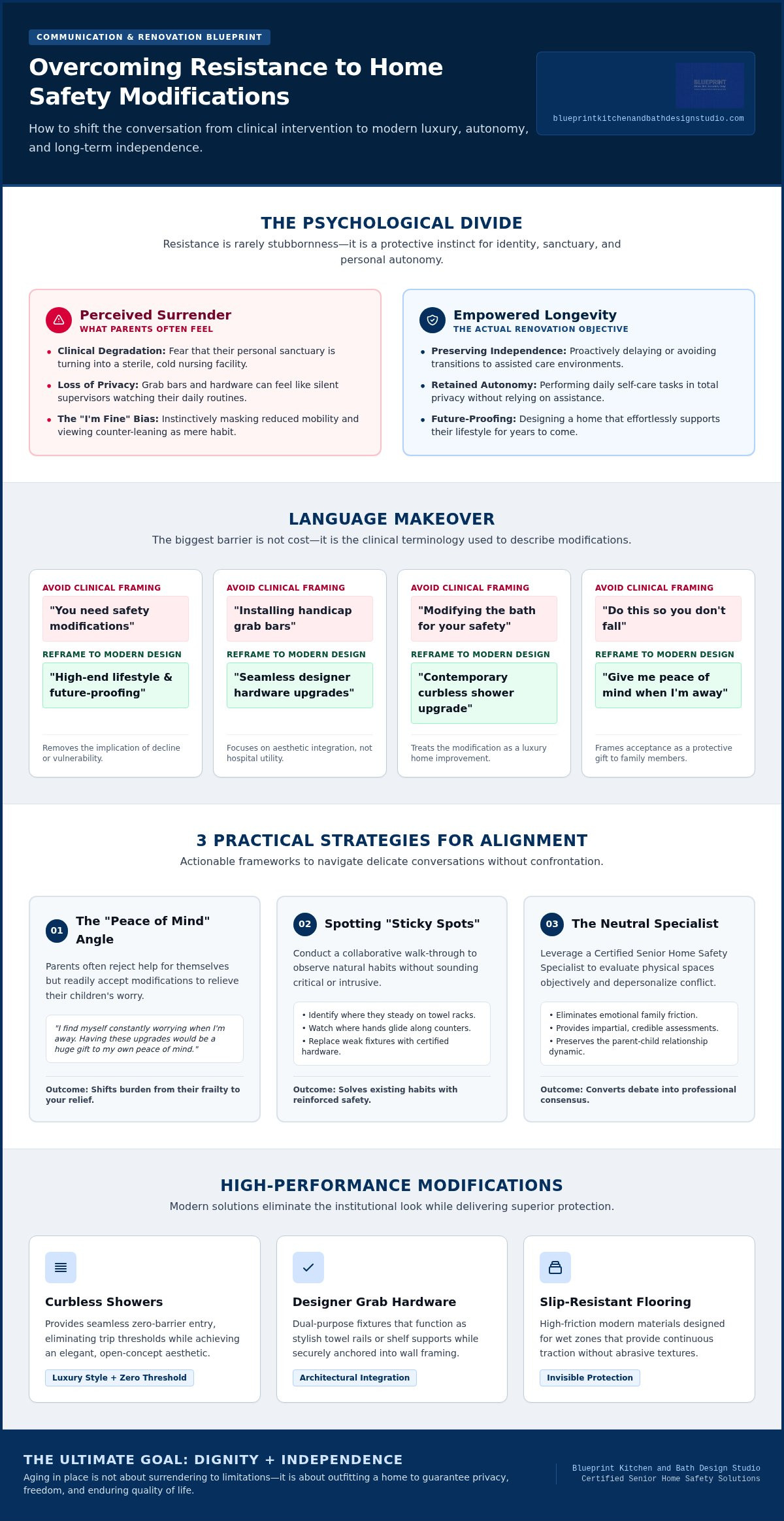
Home is more than just four walls; it's a collection of memories and a symbol of self-sufficiency. When you suggest changes, your parents might not see a safety solution. Instead, they see a white flag of surrender. This emotional attachment makes even small additions feel like an admission of weakness. They often fear their sanctuary will slowly transform into a clinical environment, stripping away the comfort they've spent decades building. Understanding how to convince parents to accept home modifications begins with recognizing that their resistance isn't stubbornness; it's a protective instinct for their own identity.
The strongest objection is often aesthetic. No one wants their master suite to resemble a nursing home. This fear of the hospital look causes many seniors to reject vital upgrades. To move forward, we must first validate these feelings. Shifting the conversation from "you need this" to "I want you to be comfortable" changes the dynamic from a demand to a collaborative effort. Focusing on the goal of aging in place allows the conversation to center on longevity and independence rather than decline.
To better understand the psychological barriers parents face, watch this helpful video regarding why they may refuse help:
Dignity vs. Safety: The Internal Conflict
Safety hardware can inadvertently signal a loss of privacy. To a senior, a grab bar might feel like a silent supervisor watching their every move in the bathroom. This creates an internal conflict between their identity as a provider and the new, uncomfortable role of being cared for. When modifications feel like supervision, they are met with resistance. It's essential to frame these changes as tools that protect their privacy by allowing them to manage daily tasks without help.
Identifying the 'I'm Fine' Bias
There is often a significant gap between a parent's actual mobility and their perceived mobility. Many seniors instinctively mask their difficulties to avoid worrying their children. They might grip the towel rack or lean on the counter; they dismiss these as habits rather than necessities. Because they've adapted slowly, they don't see the risk. Using the term "future-proofing" instead of "safety" can make these upgrades feel like a proactive lifestyle choice. This approach helps when learning how to convince parents to accept home modifications because it focuses on a house that works for them for years to come.
5 Steps to Framing the Home Modification Conversation
Approaching this topic requires a shift from clinical safety talk to a conversation about lifestyle and longevity. When you explore how to convince parents to accept home modifications, the goal is to make the process feel like a collaborative home improvement project rather than a medical intervention. By following a structured path, you can address their fears while ensuring their long-term well-being.
The 'Peace of Mind' Approach
Many parents are more likely to agree to changes if they believe they are doing it for you. Frame your request as a way to reduce your own anxiety. You might say, "I worry about you when I'm not here; having these upgrades would be a huge gift to my peace of mind." This approach shifts the focus away from their perceived "weakness" and onto the health of the family dynamic. Safety for the parent is freedom for the child. Official resources, such as the National Institute on Aging's guide to aging in place, suggest that framing safety as a family-wide benefit can lower resistance significantly.
Focusing on Independence, Not Care
Professional aging in place remodeling is designed to delay or entirely prevent the move to assisted living. It's a strategy for staying in control of one's environment. Focus on the luxury and convenience of modern features. For example, curbless showers provide a sleek, contemporary look that is also incredibly easy to maintain. By letting your parents choose the hardware finishes and tile styles, you reinforce their autonomy. They aren't "getting a handicap shower"; they are "upgrading their master bath."
Learning how to convince parents to accept home modifications often involves starting with "small wins" or a trial period. Instead of suggesting a full home overhaul, propose installing a single designer grab bar in the most high-traffic area. This allows them to experience the added stability without feeling overwhelmed. If friction remains, invite a neutral third-party expert to the conversation. A local Redlands specialist can provide an objective safety assessment, acting as a professional guide rather than a family member with an agenda. This expert perspective often carries more weight and removes the emotional charge from the decision-making process. Ultimately, every modification is a tool that ensures they can stay home longer, which is the goal everyone shares. If you need help starting this process, a professional home assessment can provide the clarity you need.
Overcoming Common Objections to Safety Upgrades
Even when you understand the psychology of resistance, you'll likely face specific pushback. One of the most common hurdles in learning how to convince parents to accept home modifications is the "I'm not that old" objection. You can bypass this by using a luxury hotel comparison. High-end resorts feature curbless entries and spacious walk-in showers because they represent the pinnacle of modern design and comfort, not because the guests are frail. Reframe these changes as ergonomic upgrades that make life easier for everyone. Additionally, many parents worry about a construction mess. Professional teams specialize in streamlined, one-day installations that minimize disruption to the household routine, allowing the home to remain functional throughout the process.
The Aesthetic Myth: Safety Meets Style
Many homeowners fear that safety fixtures will ruin the curated look of their home. However, modern bathroom safety upgrades now prioritize "invisible safety." This trend utilizes hardware that serves dual purposes. You can install designer grab bars that function as elegant towel racks or soap dishes, blending seamlessly into the existing décor. These integrated styles ensure that the home remains a personal sanctuary rather than a clinical space. High-end finishes like brushed gold, polished chrome, or matte black allow these features to feel like intentional design choices that enhance the room's aesthetic value while providing necessary support.
The 'One-Trip' Cost Comparison
When the objection is financial, it's helpful to look at the long-term return on investment. The grab bar installation cost is a small fraction of the expense associated with a single emergency room visit or a week of rehabilitation. Professional installation in the Inland Empire ensures that the hardware is anchored correctly into the wall studs. This is a critical safety factor that DIY attempts often miss, as a bar that pulls out of the drywall during a fall can cause more harm than good.
According to Mayo Clinic fall prevention strategies, removing hazards and adding support are the most effective ways to maintain physical autonomy. For residents in Redlands, it's also worth investigating local senior home grants or San Bernardino County rebate programs that may be available to help offset the cost of these essential improvements. By focusing on the math of prevention, you can show that a proactive upgrade is the most fiscally responsible choice for the family's future. This logical approach is a key part of how to convince parents to accept home modifications without making them feel pressured or overwhelmed.
Conducting a Collaborative Home Safety Walk-Through
Once your parents agree to discuss their environment, the next step is a joint assessment of the home. This process works best when you act as a partner rather than an inspector. A collaborative walk-through is a practical strategy for how to convince parents to accept home modifications because it allows them to identify their own "sticky spots." These are the specific areas where they already feel a slight hesitation or reach for a wall for support. By focusing on their physical experience, you remove the emotional weight of the conversation and concentrate on functional solutions.
The 'Furniture Surfing' Test
During your walk-through, pay close attention to how your parents move from one room to another. You might notice them touching the back of a sofa, leaning on a doorframe, or gripping the edge of a kitchen counter. Furniture surfing is the habit of using household objects for balance, and it is a clear indicator that the home's current flow lacks reliable support. Many seniors also rely on "accidental grab bars" like towel rings or sink edges. These fixtures are not designed to hold weight and can be dangerous if used for stability. Identifying these habits together makes the need for professional hardware feel like a logical response to a real-world habit rather than a forced change.
Identifying Small Wins for Big Impact
A successful walk-through often starts with low-hanging fruit that provides immediate benefits. Improving lighting in hallways and removing slip-prone rugs are simple changes that build trust for larger projects. From there, you can discuss strategic grab bar placement near the toilet and inside the shower. These targeted additions provide stability where it is needed most without requiring a full renovation. For parents with more advanced mobility needs, we might also look at widening doorways or installing home access ramps to ensure every room remains accessible. This layered approach allows you to address the most critical risks first.
Because the bathroom is the most high-risk area in any home, it should always be the priority during your assessment. A systematic approach helps you identify which modifications will provide the greatest return on safety and independence. If you aren't sure where to start, you can request a professional safety walk-through to get an expert, neutral perspective on your parents' home.
Why a Certified Senior Home Safety Specialist Makes the Difference
Navigating the final steps of how to convince parents to accept home modifications often requires a change in messenger. Even with the best intentions, a child's advice can feel like an intrusion on a parent's autonomy. This is where a Certified Senior Home Safety Specialist (SHSS) provides a critical advantage. By introducing a professional, you remove the emotional friction from the family dynamic. The specialist becomes the objective authority who identifies needs based on clinical standards rather than personal worry. This allows you to remain the supportive family member while the expert handles the technical recommendations.
SHSS certification ensures that the assessment goes beyond the obvious. While a family member might only notice a slippery tub, a specialist identifies non-obvious risks like poor lighting transitions or improper counter heights. Precision is also vital during the installation phase. A grab bar is only as safe as its connection to the wall. Professional installers prioritize exact stud-finding and use specialized hardware to ensure every modification can support significant weight. This technical thoroughness transforms a simple house into a high-performance environment that promotes longevity and physical autonomy.
The Neutral Third-Party Advantage
Parents are statistically more likely to accept advice from a certified professional than from their own children. This shift in perspective is often the most effective strategy for how to convince parents to accept home modifications. Whether you are coordinating care in Banning or Beaumont, a professional assessment provides a clear, prioritized roadmap for safety. Blueprint’s specialized senior home safety remodeling services focus on this collaborative approach, ensuring that every change respects the homeowner's style and dignity.
Local Expertise in the Inland Empire
Blueprint Kitchen and Bath Design Studio understands the unique architectural styles found throughout the Inland Empire. From the historic homes in Redlands and Loma Linda to the modern layouts in Riverside and Moreno Valley, we provide solutions that feel integrated rather than added on. We offer a quick turnaround for residents in Yucaipa and Calimesa, ensuring that safety upgrades are completed with minimal delay. If you're ready to bridge the gap between safety and independence, schedule a professional safety assessment with Blueprint today to begin the conversation with confidence.
Securing Their Independence for the Future
Transitioning a home for longevity doesn't have to be a source of family conflict. By shifting the focus from physical limitations to high-end design upgrades, you can maintain your parents' dignity while ensuring their safety. We have discussed how a collaborative walk-through and the use of neutral third-party experts can remove the emotional charge from these decisions. Mastering how to convince parents to accept home modifications is ultimately about aligning on the same goal: keeping them in the home they love for as long as possible.
At Blueprint Kitchen and Bath Design Studio, we specialize in invisible safety design that blends seamlessly with your home’s existing style. Our team brings over a decade of local Inland Empire experience to every project. As SHSS Certified Specialists, we understand the technical precision and emotional intelligence required to make these transitions successful. You don't have to navigate this delicate process alone. Schedule a Reassuring Home Safety Consultation with Our Redlands Experts today. Let's work together to create a space that offers total stability and complete peace of mind.
Frequently Asked Questions
What is the best way to start a conversation about home modifications?
The best way to start is by framing the request as a gift to yourself rather than a critique of their abilities. Explain that having these features would help you sleep better at night. This shifts the focus from their aging to your peace of mind. Learning how to convince parents to accept home modifications is easier when you lead with love and a desire to see them stay in their beloved home for years to come.
How do I deal with a parent who is stubborn about safety changes?
When a parent resists, invite a neutral third-party expert like a Certified Senior Home Safety Specialist to perform an assessment. Parents often listen to a professional's objective advice more readily than a family member's suggestions. You can also reframe the changes as "future-proofing" for a luxury lifestyle rather than "safety for the elderly." This preserves their dignity while moving toward a safer environment in Banning or Beaumont.
Are there home modifications that don't look like medical equipment?
Yes, modern safety features prioritize "invisible safety" that blends with high-end décor. Designer grab bars can double as elegant towel racks or soap dishes in finishes like matte black or brushed gold. Curbless showers and slip-resistant flooring provide a sleek, contemporary look that mimics a high-end spa. These upgrades enhance the home's aesthetic value while providing necessary support in Highland or Loma Linda.
Can I install grab bars myself to save money?
DIY installation is risky because safety hardware must be anchored into wall studs to hold significant weight. If a grab bar pulls out of the drywall during a fall, it can cause more severe injuries. Professional installers use precision stud-finding and specialized hardware to ensure every modification is structurally sound. In Redlands, hiring a specialist guarantees the installation meets local building codes and provides the stability your parents need.
How much do typical home modifications for seniors cost in Redlands?
Costs for modifications in the Inland Empire are project-based and vary depending on the scope of the renovation. A simple grab bar installation is a different investment than a full curbless shower conversion. While we don't quote fixed prices without an assessment, it's helpful to compare the cost of prevention to the high expense of emergency medical care or rehabilitation. We focus on creating a tailored plan that fits your family's specific needs and budget.
What are the most critical modifications to start with?
The bathroom is the most critical area to address first because it is the primary location for home accidents. Focus on installing grab bars near the toilet and shower, followed by slip-resistant flooring. Improving lighting in hallways and adding home access ramps are also high-priority tasks. These modifications provide the most immediate impact on daily safety and independence for residents in Yucaipa or Moreno Valley.
Is there financial assistance for senior home modifications in California?
Some California residents may qualify for local assistance through San Bernardino County senior home repair programs or specific municipal grants. It's also worth checking with local non-profits in Riverside or San Bernardino that focus on senior housing. While programs change, a professional safety specialist can often point you toward current resources or rebate programs that help make aging-in-place modifications more accessible for local families.
How do I know if a contractor is qualified for senior safety work?
Look for a contractor with a SHSS Certified Senior Home Safety & Grab Bar Specialist designation. This certification ensures they understand the specific physical needs of seniors and the technical standards for safety hardware. A qualified contractor should also have extensive experience with local Inland Empire building codes. Choosing a specialist over a general contractor ensures the focus remains on physical autonomy and high-end, functional design.


