

Article by
Jake Blasco, SHSS, B-2 Licensed Contractor
Jake Blasco is a Senior Home Safety Specialist® (SHSS), B-2 Licensed Residential Remodeling Contractor, and Grab Bar Specialist serving homeowners throughout Southern California. He specializes in aging-in-place modifications, grab bar installation, bathroom safety upgrades, accessibility remodeling, fall prevention solutions, and ADA-inspired home modifications. Through Blueprint Kitchen & Bath Design Studio, Jake helps seniors, veterans, and individuals with mobility challenges remain safe, independent, and comfortable in their homes. His expertise includes bathroom safety assessments, walk-in shower conversions, accessible design, railings, ramps, and other home accessibility solutions that improve quality of life while supporting long-term independence.
Imagine standing in your kitchen, looking at a stack of heavy dinner plates on the top shelf, and feeling a familiar flash of hesitation. You know the reach will strain your shoulder, and the step stool feels less stable than it used to. It's frustrating to have a home full of storage you can't safely use, especially when those high cabinets become "dead zones" for the items you need every day. You aren't alone in wanting a kitchen that works for you, rather than against you.
Integrating kitchen cabinet pull-down shelves is more than a simple organization project; it's a strategic safety modification that preserves your dignity and autonomy. By bringing the entire contents of your upper cabinets down to a comfortable, manageable height, you eliminate the risk of falls and the physical toll of overreaching. In this guide, we'll explore how to choose the right shelving systems to create a safer, more accessible environment. You'll learn how to evaluate weight capacities and structural requirements to ensure your kitchen remains a place of confidence, ease, and modern efficiency.
Key Takeaways
- Learn how gas-assisted struts and motorized lifts work to bring high cabinet contents down to a reachable height with minimal physical effort.
- Compare the functional benefits of chrome wire baskets versus solid-bottom designs when selecting your kitchen cabinet pull-down shelves.
- Identify the critical interior measurements and potential hardware obstructions that determine which shelving system will fit your existing cabinetry.
- Discover how these modifications integrate into a broader aging-in-place strategy to eliminate the risks associated with using step stools.
- Understand the importance of professional assessment to ensure your cabinet structure can safely support the weight of heavy-duty pull-down hardware.
What Are Kitchen Cabinet Pull-Down Shelves?
Kitchen cabinet pull-down shelves are specialized mechanical inserts designed to bring the contents of high upper cabinets directly to you. Instead of leaving top shelves empty or filling them with items you'll never use, these systems turn every inch of your cabinetry into active, usable space. They represent a fundamental shift in how we approach kitchen storage, moving away from static shelves that demand physical exertion toward dynamic solutions that accommodate your natural range of motion.
The core of this technology relies on sophisticated hardware, typically utilizing either gas-assisted struts or precision motorized lifts. Gas-assisted systems provide a counter-balance that offsets the weight of your items, making the shelf feel almost weightless as you pull it down. Motorized versions offer even greater ease, allowing for touch-button operation that brings heavy stacks of plates or small appliances down to eye level without any manual lifting. This is a cornerstone of universal design, ensuring the kitchen remains functional for everyone, regardless of height or physical strength.
To see these mechanisms in action and understand how they integrate with your cabinetry, watch this helpful demonstration:
The Problem: The Danger of High Cabinets and Step Stools
Standard kitchen layouts often prioritize maximum storage volume over human ergonomics. This design choice forces many homeowners to rely on step stools, which are a significant cause of falls and injuries in the home. Reaching for heavy objects overhead also places stress on the spine and shoulders. The repetitive action of reaching and twisting to clear a cabinet face frame can lead to chronic inflammation or acute strains, especially for those managing aging joints or mobility challenges.
How Pull-Down Systems Solve Mobility Challenges
By implementing these systems, you effectively bring your storage into the "comfort zone," which is the area between your waist and chest height. This modification offers several practical benefits for a safer home:
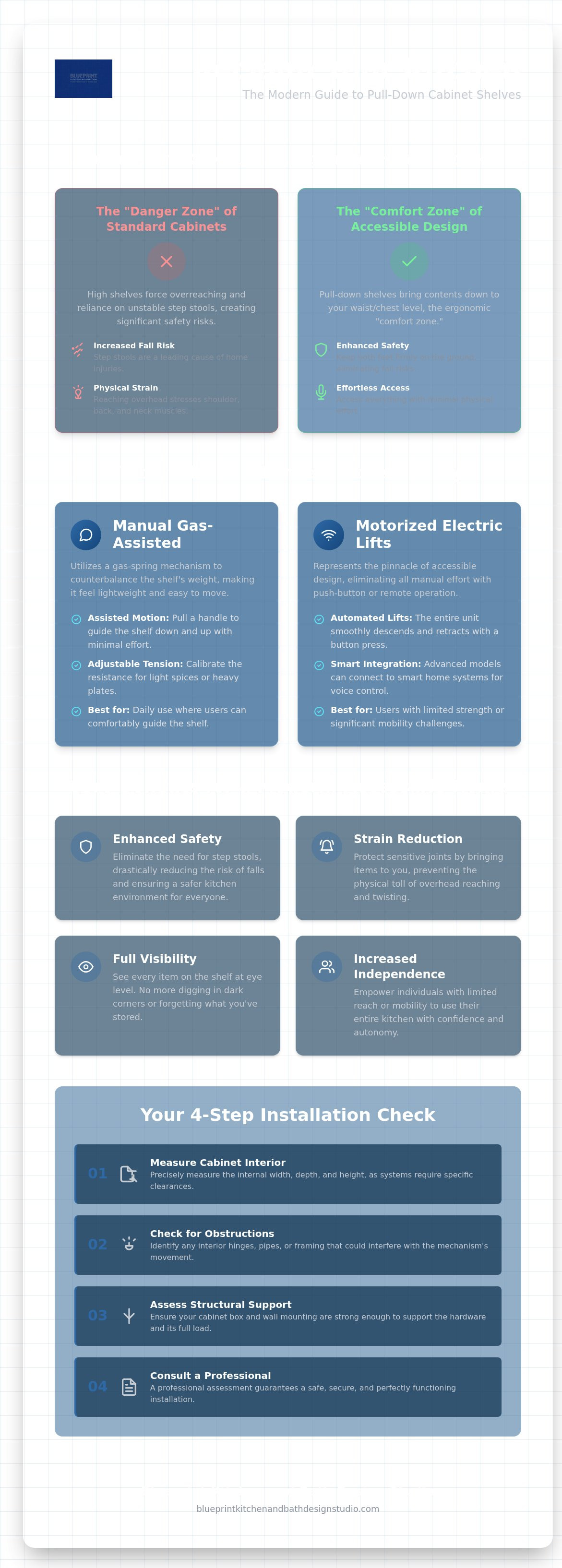
- Full visibility: You can see every item on the shelf at eye level, which reduces the need to dig through dark cabinet corners.
- Strain reduction: Bringing the shelf to you eliminates the need for overhead stretching, protecting sensitive rotator cuff muscles.
- Enhanced safety: You can keep both feet firmly on the ground at all times, removing the risk of losing your balance on a stool or chair.
- Increased independence: These modifications allow individuals with limited reach or those using mobility aids to access their entire kitchen without assistance.
Comparing Types of Pull-Down Shelving Systems
Choosing the right hardware for your kitchen requires a balance of mechanical reliability and personal physical requirements. Not all kitchen cabinet pull-down shelves are engineered the same way. Understanding the differences in lift mechanisms, materials, and weight capacities ensures your investment provides lasting comfort and safety.
Manual Gas-Assisted Pull-Downs
Manual systems are the most common choice for many households. These units utilize a gas-spring mechanism that provides a counter-balance to the weight of the shelf. When you pull the handle, the gas struts engage to assist the downward movement and, more importantly, help you lift the shelf back into the cabinet. Most high-quality models feature adjustable tension settings. This allows you to calibrate the resistance based on whether you are storing lightweight spices or heavier ceramic plates. These systems are ideal for daily-use items where you still possess the basic arm strength to guide the shelf through its arc of motion.
Motorized and Electric Cabinet Lifts
For those managing significant mobility challenges or severe arthritis, motorized lifts represent the pinnacle of accessible design. These systems eliminate manual effort entirely. With a simple push-button or remote control, the entire shelving unit descends smoothly from the cabinet. Some advanced models even integrate with smart home systems for voice-activated access. This technology is particularly beneficial for individuals with limited grip strength who might find a manual handle difficult to operate. If you're unsure which mechanism suits your current and future needs, a professional accessible kitchen design assessment can help determine the most supportive configuration for your home.
Beyond the lift mechanism, you must also consider the physical construction of the shelving units. You'll typically choose between two primary styles:
- Chrome Wire Baskets: These offer excellent visibility from below, making it easy to identify items through the wire mesh. They are often the most cost-effective and lightweight option.
- Solid-Bottom Designs: Often called "cloud" shelves, these feature a flat surface that prevents small items from tipping or falling through. They provide a more modern, high-end look and are easier to wipe clean.
Finally, pay close attention to weight capacities. Standard units typically support 15 to 20 pounds, which is sufficient for glassware or pantry staples. However, if you plan to store heavy small appliances or cast iron cookware, you'll need heavy-duty units rated for 30 pounds or more. Choosing a double-tier configuration can maximize your vertical space, but it's vital to ensure your cabinet's structural integrity can handle the increased load of the hardware and its contents.
The Role of Pull-Down Shelves in Aging-in-Place
The kitchen is often the most used room in a home, but it can also become the most challenging as physical needs change. Successfully implementing aging in place remodeling in Redlands requires looking beyond grab bars and wider doorways. It involves rethinking every interaction you have with your environment, especially vertical storage. Integrating kitchen cabinet pull-down shelves allows you to maintain your culinary routines without the physical barriers that lead to fatigue or injury.
Reducing the physical toll of meal preparation and kitchen cleanup is essential for maintaining a healthy lifestyle. When you don't have to struggle with heavy stacks of plates or reach for distant pantry items, you have more energy for the activities you enjoy. These systems act as a force multiplier, assisting with the heavy lifting that often makes cooking feel like a chore. Beyond the physical ease, there is a profound psychological benefit to these modifications. Being able to reach your own dishes and cookware fosters a sense of dignity and self-reliance. It keeps you in control of your daily life, ensuring your home remains a place of comfort rather than a source of frustration.
Ergonomics and Joint Protection
Standard cabinets force users to reach above their heads, which places significant stress on the rotator cuff and lower back. These repetitive movements can lead to chronic pain or limited mobility over time. Pull-down hardware addresses this by bringing items into the neutral reach zone. The neutral reach zone is the area between your waist and shoulder height where you can access items with your elbows close to your body and your spine in a relaxed, natural alignment. This posture minimizes strain and protects your joints from the wear and tear of overextension.
Fall Prevention in the Kitchen
The risk of falling increases significantly when seniors attempt to reach high shelves or climb onto unstable step stools. Many household accidents occur during these brief moments of overreaching when balance is compromised. By eliminating the "climb," you create a much safer environment. This is especially critical for those using walkers or wheelchairs, as it allows for full cabinet utility from a seated or braced position. A holistic approach to safety means coordinating these kitchen changes with other essential modifications, such as bathroom safety upgrades in Redlands, CA, to ensure every room in your home supports your long-term well-being and physical autonomy.
Planning Your Installation: Measurements and Requirements
Successful integration of kitchen cabinet pull-down shelves begins with a meticulous assessment of your existing cabinetry. It isn't enough to simply find a unit that fits the width of your cupboard. You must ensure the entire cabinet box can support the dynamic weight of a moving shelf system. A thoughtful planning phase prevents mechanical failure and ensures the hardware operates with the effortless glide you expect from high-end accessibility modifications.
Follow these four essential steps to prepare for your upgrade:
- Step 1: Precise Interior Measurements. Measure the clear opening width, the total interior depth, and the vertical height. Remember to measure between the narrowest points, such as the space between cabinet face frames rather than the wider interior box.
- Step 2: Identify Obstructions. Check for protruding hinges, under-cabinet lighting, or decorative trim. Even a small screw head or a slightly misaligned hinge can catch the mechanism and cause it to jam.
- Step 3: Evaluate Structural Integrity. Pull-down systems exert significant leverage on the cabinet's back and side panels. Many standard cabinets require reinforcement or specialized mounting plates to ensure the hardware doesn't pull away from the wall over time.
- Step 4: Determine the Pull-Down Stroke. Different models have different "drop" distances. You must choose a stroke that brings the shelf low enough for comfortable access without hitting your countertop, faucet, or backsplash.
Understanding Weight Limits and Balance
Calculating the "loaded weight" of your items is a critical safety step. If you intend to store heavy ceramic dinnerware, you must select a heavy-duty unit rated for at least 30 pounds. Overloading a standard unit leads to premature failure of the gas-assisted struts, which can cause the shelf to drop unexpectedly. Balanced loading is equally important. Distributing weight evenly across the shelf prevents the tracks from binding and ensures the lift assistance remains smooth and predictable. Professional-grade hardware is engineered with robust materials that outperform generic DIY kits, providing the stability needed for long-term use.
DIY vs. Professional Installation
While some homeowners consider this a weekend project, DIY installations often face significant pitfalls. Misaligned tracks are a common issue; if the rails aren't perfectly parallel and level, the shelf will squeak, bind, or fail to lock in the downward position. Precision leveling is non-negotiable for the longevity of the gas-spring mechanisms. Working with a senior home safety remodeling expert provides peace of mind that your mounting points are secure and the ergonomics are tailored to your specific reach. If you want to ensure your kitchen is both beautiful and functional, schedule an accessible kitchen design assessment to review your cabinet structural needs.
Accessible Kitchen Design in Redlands and the Inland Empire
Blueprint Kitchen and Bath Design Studio understands that a safe home requires more than isolated hardware updates. In Redlands and the surrounding Inland Empire, we specialize in integrating kitchen cabinet pull-down shelves into a comprehensive plan that addresses your specific mobility needs. This holistic approach ensures that your modifications don't just solve one problem but create a seamless, high-functioning environment. For instance, we often coordinate the installation of these shelving units with wheelchair accessible kitchen countertops in Redlands. By aligning the drop-down height of your shelves with the knee-clearance height of your counters, we create a unified work triangle that is fully accessible from a seated position.
Local architectural variety presents unique challenges for accessibility. Historic Redlands homes often feature heavy, solid-wood cabinetry that requires specific structural reinforcement before installing heavy-duty hardware. Conversely, modern Inland Empire builds might use lighter materials that need specialized mounting plates to handle the leverage of a loaded shelf. A professional home safety assessment is the first step in determining which hardware is appropriate for your specific cabinet construction. This ensures the longevity of the modification and protects the integrity of your home’s original craftsmanship.
A Holistic Approach to Kitchen Safety
True accessibility is found in the small details that support your daily routine. We recommend pairing your new shelving with D-shaped cabinet pulls, which are much easier to grip for those with limited hand dexterity or arthritis. Additionally, adding integrated task lighting to the underside of the pull-down units significantly improves visibility as the shelf descends into the workspace. This creates a safety-first workflow where every movement is supported by clear sightlines and ergonomic hardware, reducing the risk of accidents during meal preparation.
Why Work with a Certified Aging-in-Place Specialist?
A general contractor might understand how to install a shelf, but a Certified Senior Home Safety Specialist understands how that shelf interacts with your physical routine. It's about ensuring all modifications meet ADA standards and provide long-term stability as your needs evolve. Residents in Redlands, Loma Linda, and Riverside can rely on our specialized expertise to manage complex structural installations with sensitivity to their home’s aesthetic. If you're ready to transform your kitchen into a safer, more independent space, scheduling a professional design consultation is the most effective way to start your journey toward physical autonomy and peace of mind.
Transform Your Kitchen into a Safe, Independent Workspace
Making every cabinet accessible is the first step toward a kitchen that truly works for you. By integrating kitchen cabinet pull-down shelves, you eliminate the physical strain of overreaching and the hidden hazards of using step stools. These modifications represent more than just smart storage; they're essential tools for maintaining your autonomy and dignity at home. You deserve a space that adapts to your needs rather than forcing you to adapt to its limitations.
As SHSS Certified Senior Home Safety specialists, Blueprint Kitchen and Bath Design Studio provides expert aging-in-place remodeling for the Inland Empire. We focus on ADA-compliant and universal design principles to ensure your modifications are as durable as they are beautiful. Our team understands the delicate balance between clinical safety requirements and high-end home aesthetics, ensuring your kitchen remains a place of comfort and style.
Don't let high cabinets limit your independence any longer. Schedule Your Accessible Kitchen Design Consultation in Redlands Today to create a space that supports your movement and your lifestyle. We're here to help you build a safer, more confident future in the home you love.
Frequently Asked Questions
Are kitchen cabinet pull-down shelves difficult to pull down if you have arthritis?
No, these systems are engineered specifically to assist with mobility challenges. Manual units use gas-assisted struts to offset the weight of the contents, requiring very little pulling force to operate. For those with severe arthritis or limited grip strength, motorized options provide touch-button operation. This eliminates the need for manual pulling entirely, ensuring that every item remains accessible without causing joint pain or physical flare-ups during daily kitchen tasks.
How much weight can a standard kitchen pull-down shelf actually hold?
Weight capacities vary depending on the model's engineering and the quality of the hardware. Standard units typically support between 15 and 20 pounds, which is ideal for glassware or dry goods. Heavy-duty versions are rated for 30 pounds or more, making them suitable for stacks of ceramic plates or small appliances. It's vital to choose a unit that matches your intended use to prevent mechanical failure and ensure smooth, safe operation over time.
Can pull-down shelves be installed in my existing kitchen cabinets?
Yes, most modern systems are designed for retrofitting into your existing cabinetry. Installation involves mounting the hardware to the interior side walls or the cabinet floor. However, the success of the project depends on the structural integrity of your current cabinets. A professional assessment ensures that the wood and wall mounting are strong enough to support the added weight and mechanical leverage of the kitchen cabinet pull-down shelves without causing damage.
Do pull-down shelves work with cabinets that have face frames or inset doors?
Pull-down systems are compatible with both face-frame and frameless cabinets. When working with face frames, you must use spacers or specific mounting hardware to ensure the shelf clears the frame as it descends. Inset doors require careful measurement to ensure the hardware doesn't interfere with the door's closing mechanism. Accurate interior dimensions are the key to a seamless fit, and professional installers can adjust the tracks to accommodate these specialized cabinet styles.
What is the best material for pull-down shelving: wire or solid bottoms?
The best material depends on your specific needs for visibility and stability. Chrome wire baskets offer superior visibility from below, which helps you identify items quickly. Solid-bottom shelves, often called "cloud" designs, prevent small items like spice jars from tipping over or falling through the mesh. Solid surfaces are generally easier to wipe clean, while wire designs are often lighter and more cost-effective for standard storage needs in a modern kitchen.
Are motorized pull-down shelves worth the extra cost for seniors?
Motorized units are an excellent investment for individuals with significant mobility limitations or chronic pain. While manual gas-spring systems are effective, they still require some arm movement and reach. Electric lifts remove all physical resistance, bringing items down with a simple remote or wall switch. For seniors living independently in Redlands or Loma Linda, this added ease can be the difference between using the kitchen safely or avoiding high storage areas entirely.
How do I know if my cabinets are strong enough to support a pull-down unit?
You should look for cabinets made of solid wood or high-quality plywood rather than thin particle board. The shelving hardware places significant stress on the cabinet's side panels and the wall studs behind them. If your cabinets are older or show signs of sagging, they may require reinforcement. A Certified Senior Home Safety Specialist can evaluate your kitchen's structural integrity before installation to ensure a stable, long-term solution for your home.
What is the standard width for pull-down shelving inserts?
Most kitchen cabinet pull-down shelves are manufactured to fit standard cabinet widths of 24, 30, or 36 inches. However, the internal clear opening is the dimension that matters most. Manufacturers provide specific minimum and maximum interior width requirements for each model. It's essential to measure the narrowest point of your cabinet opening, usually between the hinges or the face frame, to ensure the hardware can pass through without catching or damaging the wood.


