

Article by
Jake Blasco, B-2 Licensed Contractor
Jake Blasco leads design and project planning at Blueprint Kitchen & Bath Design Studio, specializing in kitchen, bath, and whole home design in Huntington Beach and surrounding Orange County communities. His approach combines thoughtful layouts, quality materials, and practical construction knowledge to create spaces that look beautiful and work for everyday life.
Jake shares guidance on cabinetry, countertops, finishes, lighting, and renovation planning to help homeowners make informed decisions. As the qualifying individual for Blueprint’s California B-2 Residential Remodeling license (CSLB #1161570), he brings a construction perspective to every design.
Did you know that a single fall-related hospital visit now costs an average of over $62,000? For many homeowners in Redlands and the Inland Empire, the financial risk of a home accident is a heavy burden to carry. Securing financing for aging in place modifications is often the most critical step in protecting both your physical health and your hard-earned savings.
It's understandable to feel anxious about the costs of essential upgrades like curbless showers or walk-in tubs, especially when insurance coverage feels confusing. You deserve to maintain a beautiful home that supports your dignity without depleting your retirement fund. This 2026 guide provides a clear path to funding these safety improvements through specialized grants, tax incentives, and strategic financing. We will review specific programs like VA HISA grants, the USDA Section 504 program, and the latest home equity trends to help you make an informed, confident decision for your future.
Key Takeaways
- Compare the long-term financial benefits of a one-time safety remodel against the rising monthly costs of assisted living facilities.
- Identify specific 2026 government assistance programs, including USDA Section 504 and VA grants, that fund essential structural safety improvements.
- Evaluate private funding options such as HELOCs and reverse mortgages to secure the right financing for aging in place modifications while protecting your home equity.
- Uncover often-overlooked funding sources like IRS medical expense deductions and specialized tax credits for accessibility improvements.
- Learn why a professional safety assessment is the essential first step to ensure your funding is applied to the most impactful home upgrades.
Understanding the Value: Why Financing Home Modifications is a Strategic Move
Aging in place modifications are functional upgrades designed to support physical autonomy and long-term independence. While the initial cost of a renovation may seem substantial, securing financing for aging in place modifications is a proactive move that preserves your wealth. When you compare a one-time investment in your home to the recurring, ever-increasing monthly fees of assisted living facilities, the financial logic is undeniable. Choosing to modify your current residence allows you to stay in a familiar environment, which provides a level of psychological comfort and dignity that institutional settings cannot match.
The concept of Aging in Place centers on the ability to live in your own home safely and comfortably, regardless of age or mobility level. It's a lifestyle choice that prioritizes your history and community connections. By viewing these upgrades as a strategic investment rather than a medical necessity, you can approach the financing process with confidence and clarity.
The ROI of Safety: Preventing the Fall
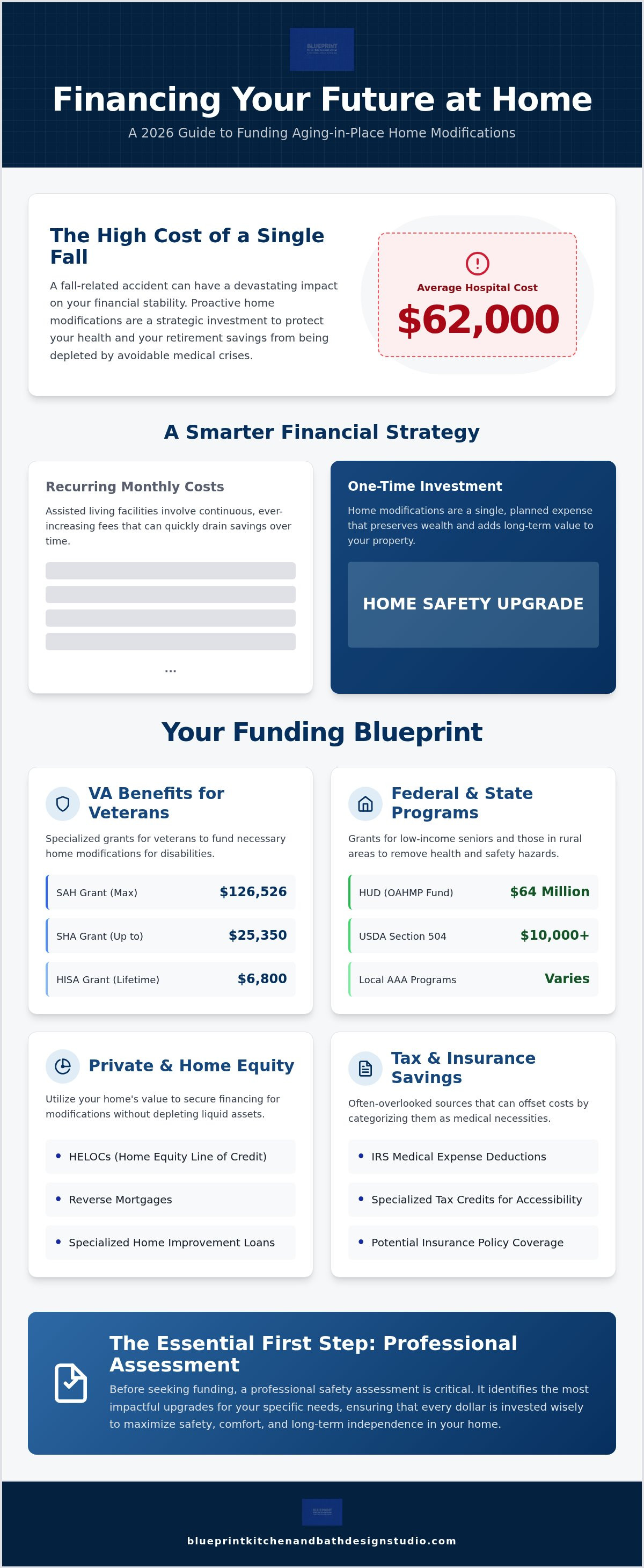
A single slip-and-fall accident can have a devastating impact on your financial stability. Data from July 2026 shows that a single fall-related hospital visit costs, on average, over $62,000. When you install features like grab bars or slip-resistant flooring, you're directly reducing the risk of these high-cost medical emergencies. Curbless showers are particularly effective; they eliminate dangerous thresholds, which significantly lowers the likelihood of needing expensive long-term nursing care. Proactive home modification is a sophisticated financial strategy that protects your retirement savings from being depleted by avoidable healthcare crises.
Home Value and Accessibility
There is a common misconception that accessibility features hurt a home's resale value. In reality, modern universal design features appeal to a growing demographic of buyers, including multi-generational families and those planning for their own futures. Professional aging in place remodeling Redlands experts provide ensures that safety doesn't come at the expense of style. By integrating high-end aesthetic design with structural stability, you maintain a beautiful home that remains highly competitive in the Inland Empire real estate market. This balance of clinical precision and domestic comfort ensures your home is a safer, more efficient space for anyone who enters it.
Public Grants and Government Assistance for Home Safety
Finding financing for aging in place modifications often begins with government-sponsored programs. These resources are designed to help you stay in your home by covering the costs of vital safety upgrades. Local resources in San Bernardino County, such as the Area Agency on Aging (AAA), provide guidance on eligibility for state-funded programs that assist low-income seniors with home repairs. It's often a matter of matching your specific needs with the right federal or local bucket of funding.
VA Benefits for Inland Empire Veterans
For veterans living near the Loma Linda VA Medical Center, several specialized grants offer significant support. The Home Improvements and Structural Alterations (HISA) grant provides a lifetime benefit of up to $6,800 for veterans with service-connected disabilities. If the disability isn't service-connected, the benefit is up to $2,000. These funds are ideal for essential changes like grab bar installation or doorway widening. Additionally, the Specially Adapted Housing (SAH) grant has a maximum of $126,526 for fiscal year 2026, while the Special Home Adaptation (SHA) grant offers up to $25,350. The National Institute on Aging emphasizes that these modifications are vital for maintaining independence as your mobility needs change.
HUD and USDA Rural Development Grants
The USDA Section 504 Home Repair program is a powerful resource for seniors aged 62 and older who live in rural areas of the Inland Empire. This program provides grants of up to $10,000 to remove health and safety hazards. In federally declared disaster areas, this grant can increase to $15,000. To qualify, you must be the homeowner and meet specific very-low-income requirements. HUD's Older Adults Home Modification Grant Program (OAHMP) also contributes to this landscape, with $64 million available in the current funding cycle ending August 31, 2026. These grants help cover the costs of professional labor and high-quality materials for structural modifications.
Navigating these applications requires precision and patience. You should contact the San Bernardino County Housing Authority to discuss Community Development Block Grants (CDBG), which often fund local accessibility projects. Before you apply, it is helpful to have a professional home assessment to identify exactly which structural changes will provide the most benefit. Having a clear, documented plan from a specialist ensures you apply for the correct amount of funding and helps speed up the approval process with government agencies.
Private Financing: Home Equity and Specialized Loans
For many homeowners in Redlands, private equity is the most accessible path for financing for aging in place modifications. Unlike government grants, which often have rigid income ceilings, private financing allows for high-end materials and custom designs that blend safety with luxury. As of September 2026, the national average interest rate for a home equity loan is 8.13%. This fixed-rate option provides a predictable lump sum, making it ideal for comprehensive projects like curbless showers or doorway widening. It's a structured way to fund significant structural changes while maintaining a clear repayment schedule.
A Home Equity Line of Credit (HELOC) offers more flexibility, allowing you to draw funds as needed for phased upgrades. This is particularly useful if you're planning a series of modifications over several years. For larger-scale renovations, a Home Equity Conversion Mortgage (HECM), or reverse mortgage, can provide significant capital for those aged 62 and older. While these products eliminate monthly mortgage payments, it's vital to understand the long-term impact on your home's equity. Specialized "Aging in Place" loan products from private lenders are also emerging, often featuring terms tailored to the specific timelines of home health transitions.
Leveraging Your Home's Value Safely
When you're deciding between a cash-out refinance and a second mortgage, look closely at your current primary mortgage rate. If you secured a low rate years ago, a second mortgage or the USDA Section 504 Home Repair program loan, which offers a 1% interest rate for qualifying very-low-income seniors, is often more cost-effective. Investing in professional bathroom safety upgrades justifies the use of equity because these modifications directly increase the home's functional longevity. High-quality accessible design doesn't just make the home safer; it enhances the property's appeal to a wider range of future buyers who value universal design features.
Credit and Financing for Smaller Projects
Smaller, high-impact tasks like grab bar installation for seniors may not require a full home equity loan. Personal lines of credit or low-interest credit cards can be used strategically to cover material costs while you pay for expert labor out of pocket. This approach avoids the closing costs associated with equity-based loans. However, you must be cautious of predatory lending in the home improvement sector. Some contractors offer "instant" financing with hidden fees or ballooning interest rates. Always verify that your partner is a specialized expert who prioritizes your long-term stability over a quick sale. Choosing the right financing for smaller projects ensures you don't overextend your credit for essential safety needs.
Tax Incentives and Insurance: Hidden Funding Sources
Many homeowners overlook the significant role tax law and insurance policies play in financing for aging in place modifications. While grants and loans provide immediate capital, tax deductions and insurance reimbursements offer a way to recoup costs or offset your investment. These "hidden" sources require meticulous documentation and a clear understanding of federal regulations, but they often provide the final piece of the puzzle for a comprehensive home safety plan.
IRS Publication 502: The Medical Necessity Rule
The IRS allows you to deduct certain home improvement costs as medical expenses if their primary purpose is medical care for you, your spouse, or your dependents. Under Publication 502, modifications like widening doorways, installing ramps, or adding porch lifts are often fully deductible. If the modification increases your home's value, you can deduct the difference between the cost of the project and the increase in property value. For example, if a walk-in tub installation costs $10,000 but only adds $2,000 to your home's resale value, $8,000 may be eligible for a deduction. To secure this benefit, you must obtain a letter from a physician stating that the upgrades are medically necessary. You should also keep detailed receipts and "before and after" photos to support your claim during tax season.
Insurance Nuances for Inland Empire Residents
Understanding the "Medicare Myth" is essential for realistic financial planning. Standard Medicare Part A and Part B generally do not cover structural home modifications because they're classified as home improvements rather than Durable Medical Equipment (DME). However, many Medicare Advantage (Part C) plans in the Inland Empire have begun offering supplemental benefits that may cover safety devices like grab bars or temporary ramps. If you carry a Long-Term Care Insurance (LTCI) policy, review your "bed reservation" or "home modification" clauses. Many modern policies include a specific benefit amount to fund home changes that delay entry into a care facility.
In addition to medical deductions, the 25C Energy Efficient Home Improvement Credit may apply if your remodel includes high-efficiency windows or improved insulation to help regulate home temperature. This credit can provide up to $1,200 annually for qualifying weatherization. Because insurance providers and tax auditors require proof of professional standards, starting with a senior home safety remodeling assessment is the most reliable way to document the need for these upgrades. To ensure your project meets the strict criteria for insurance claims or tax deductions, you can request a professional assessment from a certified specialist today.
Executing Your Vision with Blueprint Kitchen and Bath
Once you've identified the right financing for aging in place modifications, the focus shifts to the precise execution of your project. Securing funding is a significant milestone, but applying those resources to the correct structural changes requires a specialized perspective. At Blueprint Kitchen and Bath Design Studio, we believe that a professional assessment by an SHSS Certified Senior Home Safety specialist is the most critical step in the process. This evaluation ensures that your investment is directed toward the modifications that will provide the greatest impact on your daily stability and long-term independence.
Coordinating with contractors who truly understand ADA and safety standards is essential for a successful remodel. General contractors often overlook the subtle ergonomic details that make a space truly accessible, such as the exact height of a grab bar or the necessary turn radius for a walker. Our process begins with a detailed consultation in Redlands, where we listen to your specific needs and aesthetic preferences. We then move through a methodical design and installation phase that prioritizes your safety without compromising the beauty of your home. If your budget requires a phased approach, we typically recommend starting with high-risk areas like the bathroom, where the majority of home accidents occur.
The Professional Assessment Advantage
Choosing a specialist for your installation is far more cost-effective than correcting the errors of a DIY project or a non-specialized contractor. Mistakes in waterproofing or structural bracing can lead to expensive repairs down the road. Blueprint handles the complex technical requirements of curbless shower installation, ensuring that drainage is perfect and the transition is seamless. The Blueprint Standard represents our commitment to clinical precision blended with high-end design, ensuring that your home feels like a sanctuary rather than a medical facility. This approach protects your financing for aging in place modifications by ensuring the work is done correctly the first time.
Local Expertise in the Inland Empire
Our team is deeply rooted in the Inland Empire, serving families in Redlands, Loma Linda, Riverside, and the surrounding mountain communities. This local presence is a distinct advantage; we're familiar with the specific permitting requirements and building codes across San Bernardino County, which leads to a faster project turnaround. We understand the unique architectural styles of our region and how to integrate modern safety features into classic Southern California homes. We treat every modification as an empowering lifestyle upgrade, providing the calm authority and technical proficiency you need during this transition. Schedule your professional home safety assessment today to begin the journey of maintaining your dignity and peace of mind at home.
Secure Your Future Independence Today
Investing in your home is a strategic decision that pays dividends in safety, dignity, and long-term financial stability. The one-time cost of structural safety upgrades is significantly lower than the recurring expenses of assisted living facilities. By utilizing available grants, tax incentives, and private equity, you can transform your current residence into a space that supports your changing needs without compromising on style. Successfully securing financing for aging in place modifications is the first step toward a worry-free future in the home you love.
Blueprint Kitchen and Bath Design Studio is here to help you bridge the gap between financial planning and professional execution. As a locally owned studio in Redlands, CA, we specialize in ADA-compliant bathroom design and high-end accessibility remodels. Our team includes SHSS Certified Senior Home Safety Specialists who understand the clinical precision required for a truly safe environment. Don't leave your safety to chance or unspecialized contractors. Book Your Home Safety Assessment with Our Certified Specialists to ensure your home remains a sanctuary of comfort for years to come. You deserve the peace of mind that comes with a home that is as safe as it is beautiful.
Frequently Asked Questions
Does Medicare pay for aging in place modifications like grab bars?
Standard Medicare Part A and Part B do not cover grab bars because they are classified as home improvements rather than durable medical equipment. However, some Medicare Advantage plans in the Inland Empire offer supplemental benefits that may fund safety devices. You should review your plan's Evidence of Coverage to see if "home safety" is listed as a benefit. For most residents in Redlands, grab bar installation is an out-of-pocket expense or funded through private financing for aging in place modifications.
Are home accessibility modifications tax deductible in 2026?
Home accessibility modifications are often tax deductible if they're medically necessary. According to IRS Publication 502, you can deduct the cost of improvements that don't increase your home's value, or the portion of the cost that exceeds the value increase. This includes features like doorway widening and ramp installation. The proposed Senior Accessible Housing Tax Credit Act of 2026, if passed, would offer a nonrefundable credit of up to $10,000 for qualifying taxpayers who make safety upgrades.
What is the best way to finance a walk-in tub installation?
A walk-in tub is a significant investment that's often best funded through a Home Equity Line of Credit (HELOC) or a fixed-rate Home Equity Loan. These options allow you to leverage your home's value at lower interest rates than personal loans or credit cards. Some homeowners in the Inland Empire also use a Home Equity Conversion Mortgage (HECM) to cover larger remodels. Professional installation ensures the project meets safety standards, protecting the long-term value of your property.
Can I get a grant for home repairs if I am a veteran in California?
Veterans in California can access several federal grants for home repairs. The VA offers the Specially Adapted Housing (SAH) grant, the Special Home Adaptation (SHA) grant, and the Home Improvements and Structural Alterations (HISA) grant. Veterans near the Loma Linda VA Medical Center should consult with their primary care provider to begin the HISA application process. These funds can be used for essential modifications like curbless showers and ramps to improve daily mobility and independence in your home.
How do I prove a home modification is medically necessary for the IRS?
To prove a modification is medically necessary for the IRS, you must obtain a written recommendation from a licensed physician. This letter should clearly state that the improvement is required to treat a medical condition or accommodate a physical disability. Additionally, having a professional assessment from a SHSS Certified specialist provides documentation of the structural need. Keeping detailed receipts and "before and after" photographs of the work is essential for supporting your financing for aging in place modifications claims.
What is the difference between an SAH grant and a HISA grant?
The Specially Adapted Housing (SAH) grant is designed for veterans with permanent and total service-connected disabilities, offering up to $126,526 in 2026 for major adaptations. In contrast, the Home Improvements and Structural Alterations (HISA) grant is available to a broader range of veterans for smaller structural changes, providing up to $6,800 for service-connected conditions. While SAH often covers whole-home remodeling, HISA is typically used for specific bathroom safety improvements or entrance ramps to facilitate easier home access.
Are there local grants for seniors in San Bernardino County?
Seniors in San Bernardino County may qualify for assistance through the Department of Aging and Adult Services (DAAS). Programs like the Community Development Block Grant (CDBG) often fund local accessibility projects for low-income residents in cities like Highland and Riverside. Additionally, the USDA Section 504 Home Repair program provides grants up to $10,000 for qualifying rural homeowners aged 62 and older. It's advisable to contact the local Area Agency on Aging to verify current funding availability and eligibility requirements.
How much of my home's equity can I use for remodeling?
Most lenders allow you to borrow up to 80% or 85% of your home's appraised value, minus any existing mortgage balance. With the national average interest rate for home equity loans at 8.13% in September 2026, it's a stable way to fund high-end safety remodels. Using this equity for accessibility upgrades is a strategic choice because it improves the home's functional longevity. Residents in Redlands often find that these modifications maintain or even enhance the property's overall market appeal.
Disclaimer
This article provides general educational information and design inspiration, not project-specific professional advice. Costs, timelines, permit requirements, building codes, and product suitability vary by property and jurisdiction. Final scope, pricing, and specifications are established only through a written proposal or contract. Consult qualified professionals and local building officials before beginning work. Unless expressly identified as a completed Blueprint project, images are illustrative and may include stock photography, design renderings, or AI-generated imagery.


