

Article by
Jake Blasco, SHSS, B-2 Licensed Contractor
Jake Blasco is a Senior Home Safety Specialist® (SHSS), B-2 Licensed Residential Remodeling Contractor, and Grab Bar Specialist serving homeowners throughout Southern California. He specializes in aging-in-place modifications, grab bar installation, bathroom safety upgrades, accessibility remodeling, fall prevention solutions, and ADA-inspired home modifications. Through Blueprint Kitchen & Bath Design Studio, Jake helps seniors, veterans, and individuals with mobility challenges remain safe, independent, and comfortable in their homes. His expertise includes bathroom safety assessments, walk-in shower conversions, accessible design, railings, ramps, and other home accessibility solutions that improve quality of life while supporting long-term independence.
What if the very walls designed to protect your family are the ones currently limiting your independence? For many homeowners in Redlands, the realization that a standard door frame is too narrow for a wheelchair doesn't just create a physical barrier; it creates a sense of confinement within your own sanctuary. Professional doorway widening for wheelchair access is more than a simple renovation task. It's a precise structural modification that ensures every room in your home remains open to you, regardless of mobility changes.
It's natural to feel overwhelmed by the technicalities of residential building codes or the fear of accidentally compromising a load-bearing wall. You want a home that's fully accessible, but you don't want it to look like a medical facility. This guide provides the clarity you need to move forward with confidence. We'll explore the critical 32-inch clear width rule, the structural requirements for different wall types, and the professional methods used to ensure a seamless transition. You'll gain a clear understanding of the factors that influence project costs and how to find a local expert who can handle the structural work while maintaining your home's high-end aesthetic.
Key Takeaways
- Understand the 32-inch "clear width" standard and why measuring the door frame alone often falls short of ensuring safe wheelchair passage.
- Evaluate different modification levels, from simple offset hinges to full structural expansions, to find the most efficient solution for your specific layout.
- Identify the hidden complexities of load-bearing walls and utility relocation that must be addressed during professional doorway widening for wheelchair access.
- Gain a clear roadmap of the installation process, including how to navigate local building codes and permitting requirements in the Redlands area.
- Discover how widening entries serves as a foundation for broader home mobility improvements, such as curbless showers and accessible kitchen designs.
Understanding the ADA Standards for Doorway Widening
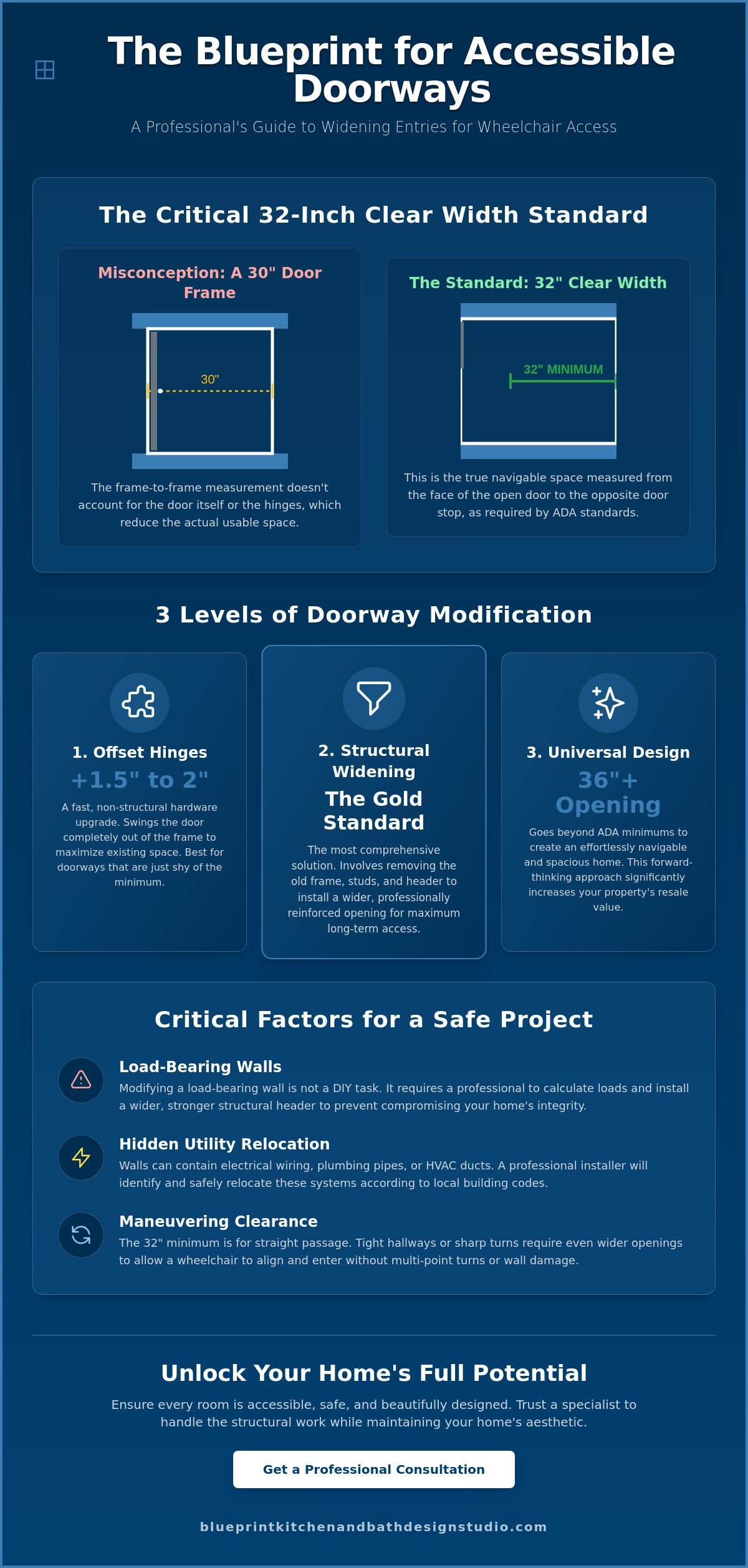
Successful home modification begins with technical precision. While a standard interior door often measures 30 inches, the actual space available for a wheelchair is significantly less once you account for the thickness of the door and the hinges. This is known as "clear width." It's the measurement from the face of the door, when opened at a 90-degree angle, to the opposite door stop. Achieving this specific clearance is the primary goal of any professional renovation project.
The 2010 ADA Standards for Accessible Design establish 32 inches as the absolute minimum clear width for any doorway. This requirement ensures that a standard manual wheelchair, which typically measures between 26 and 28 inches, can pass through without scraping the frame or injuring the user's hands. When planning doorway widening for wheelchair access, meeting this 32-inch threshold is the first step toward restoring autonomy and dignity within your living space.
To better understand this concept, watch this helpful video:
Simply widening the opening isn't always enough to ensure safety. You also need to consider maneuvering clearance. If a doorway is located at the end of a narrow hallway or requires a sharp turn to enter, the user needs additional space to align the chair properly. Professional installers look at the approach angle to determine if the opening needs to be even wider than the 32-inch minimum. This prevents the frustration of "multi-point turns" in tight spaces and protects your walls from impact damage.
Measuring Your Existing Doorways
To check your home's current accessibility, open your door to its full 90-degree position. Measure the gap between the door's edge and the frame. Many older homes in the Redlands area were built with 24-inch or 28-inch bathroom doors, which act as immediate bottlenecks for modern mobility equipment. Power chairs, which can be wider and heavier than manual models, often require every bit of that 32-inch clearance to operate safely without risk of getting stuck.
Universal Design vs. ADA Compliance
While ADA standards are the baseline for commercial buildings, residential best practices often lean toward "Universal Design." This philosophy suggests a 36-inch clear opening whenever possible. This wider standard provides a more spacious, high-end feel while making the home effortlessly navigable for everyone. Adopting Accessible housing standards doesn't just improve daily life; it significantly boosts the resale value of your Inland Empire property. A home that is already prepared for aging in place is a highly sought-after asset in today's market.
Methods for Widening Doorways: From Hinges to Structural Changes
Identifying the right method for your home depends on your current frame size and the specific equipment you use. There are three primary levels of modification: hardware upgrades, structural expansion, and alternative door styles. Each approach offers a different balance of complexity and utility, allowing for a tailored solution that respects both your budget and your home's architectural integrity.
Offset and Swing-Clear Hinges
Offset and swing-clear hinges are often the first consideration for minor adjustments. These specialized hinges shift the door's pivot point so it swings entirely out of the clear opening when opened at a 90-degree angle. This modification typically adds 1.5 to 2 inches of clearance without requiring any drywall work. It's a practical solution for frames that are just shy of the 32-inch requirement. However, this hardware fix is rarely sufficient for power chairs or homes where the original frame is under 30 inches wide.
Full Structural Frame Widening
Full structural frame widening represents the gold standard for long-term mobility. This process involves removing the existing door casing, the vertical studs, and the structural header above the door. A wider, reinforced header is then installed to maintain the wall's integrity and safely distribute the weight of the house. This method allows you to achieve the spacious 36-inch width often recommended for residential comfort by the ADA Standards for Accessible Design. Professional doorway widening for wheelchair access ensures the new entry matches your existing trim and paint for a seamless, high-end look.
Pocket and Barn Door Conversions
Sometimes the door's swing itself is the primary obstacle to movement. Pocket doors slide directly into the wall cavity, which eliminates the door's footprint entirely and frees up floor space. This is particularly useful in tight bathrooms or hallways where a swinging door might block a critical path. Barn doors provide a similar space-saving benefit and are often easier to install, though they may provide less sound privacy. These transitions are highly effective when integrated into a kitchen remodel for wheelchair accessibility, as they maximize the available turning radius for the user.
Choosing the right path requires a balance of structural precision and daily utility. If you aren't sure which level of modification your home requires, a professional assessment can help you map out a safe and beautiful transition. Professional doorway widening for wheelchair access provides the stability and longevity needed for a truly independent lifestyle. You might find that a comprehensive approach to home accessibility remodeling provides the most peace of mind for your family.
Critical Structural and Safety Challenges
Expanding an entryway involves more than simply cutting a wider hole in the drywall. It's a structural intervention that requires a deep understanding of your home's skeleton. When you begin doorway widening for wheelchair access, you must account for the hidden systems tucked behind your walls, including weight-bearing studs, electrical circuits, and HVAC ducting. Addressing these challenges with precision ensures that your home remains both safe and structurally sound for years to come.
One of the most overlooked aspects of this process is the transition between different flooring materials. When a doorway is widened, it often leaves a gap in the flooring where the old frame once stood. Managing this transition requires expert attention to ensure there are no tripping hazards or uneven surfaces that could catch a wheelchair's casters. A seamless threshold is essential for maintaining the unhindered movement described in this Home modification guide. Additionally, if you're widening a door that leads to a garage, you must maintain a fire-rated assembly to comply with local safety codes and protect your family from potential hazards.
Load-Bearing Wall Considerations
A wall is considered load-bearing if it supports the weight of the roof or the floor above it. Identifying these walls is critical because they rely on a specific arrangement of studs and a horizontal beam called a header to distribute weight. Removing these supports without installing a new, wider header can lead to ceiling sag, cracked drywall, or even catastrophic structural failure. In many cases, a structural engineer is necessary to calculate the required header size. These specialists typically charge between $100 and $250 per hour to ensure the modification is engineered for long-term stability and safety.
Electrical and HVAC Obstacles
Most doorways are flanked by light switches, outlets, or thermostats. Moving these components requires more than just shifting a box; it involves rerouting wires and ensuring that the new placement is both accessible and compliant with California Title 24 standards. HVAC systems also present challenges, as return air vents or thermostat sensors are frequently located near interior doors. Relocating these systems requires a methodical approach to maintain the home's energy efficiency and climate control. Professional doorway widening for wheelchair access handles these technical relocations seamlessly, ensuring that your light switches are within easy reach and your heating system continues to function perfectly after the renovation is complete.
The Professional Installation Process in the Inland Empire
The process of creating a more accessible home begins with a comprehensive site evaluation. This isn't just about measuring walls; it's about understanding how you move through your space. During an initial assessment for home accessibility remodeling Redlands, a specialist examines the specific dimensions of your wheelchair and the maneuvering clearances mentioned in previous sections. This personalized data ensures that the final result isn't just a wider door, but a functional path that supports your daily routine with precision and ease.
Permits and Local Regulations
Structural modifications in the Inland Empire require a formal permitting process to ensure long-term safety. In cities like Redlands and Riverside, any change to a load-bearing wall or the structural header must be documented and inspected by the building department. This ensures your home remains safe and maintains its structural integrity. For residents in Loma Linda and San Bernardino, local residential codes often align with the California Building Code. As of 2026, the valuation threshold for accessibility upgrades in California is $209,208.00. While a single doorway widening for wheelchair project may not reach this limit, it's essential to have a professional who understands how these regulations impact your overall renovation plan and permitting requirements.
Working with a Specialized Contractor
A general contractor might focus solely on the carpentry, but a specialist understands the unique nuances of accessibility design. This expertise is critical when coordinating doorway work with other projects, such as home access ramp installation. A specialized team also prioritizes the health of the household by implementing rigorous dust containment strategies. This is particularly important for seniors or individuals with respiratory sensitivities who may be staying in the home during construction. The goal is to minimize disruption while delivering a high-precision result that feels like a natural part of your home's design.
The construction phase concludes with a methodical final walkthrough. This is the moment where theoretical measurements meet the physical reality of your mobility equipment. Testing the doorway widening for wheelchair clearance with your specific chair allows for any final adjustments to the threshold or hinges. This unhurried approach ensures that every transition is smooth, stable, and ready for immediate use. If you're ready to start your journey toward a more accessible home, you can contact our team for a professional consultation to evaluate your structural needs and local code requirements.
Holistic Home Mobility: Beyond the Doorway
Expanding an entry is a vital structural step, but it's rarely a standalone solution. True home mobility requires a cohesive strategy where every modification works in harmony. Professional doorway widening for wheelchair access serves as the foundation for a comprehensive aging in place remodeling Redlands plan. Once the physical barriers of narrow frames are removed, you can focus on the finer details that ensure long-term safety, such as flush flooring transitions and accessible hardware placement. This integrated approach transforms a house from a series of obstacles into a unified, navigable sanctuary.
Safety also depends on what lies beneath your wheels. As doorways are widened, it's the perfect time to evaluate your home's flooring. Installing slip-resistant surfaces ensures that the transition between rooms remains stable and secure. High-traction materials prevent the common slips that occur during the pivoting movements required to navigate through a home. By addressing the entry width and the floor surface simultaneously, you create a path of travel that prioritizes both movement and stability.
Seamless Bathroom Transitions
The bathroom is often the most critical area for accessibility. Widening a bathroom door is frequently the first step toward more advanced bathroom safety upgrades Redlands CA, such as the installation of a curbless, roll-in shower. A wider opening allows for the necessary maneuvering space to approach the shower or vanity safely. It's also essential to coordinate your doorway widening for wheelchair project with strategic grab bar installation Redlands CA. Placing reinforced supports near the newly widened entry provides a steadying point as you transition into the room, ensuring that the "swing" of the door never obstructs access to vital fixtures like the toilet or sink.
The Blueprint Difference
At Blueprint Kitchen and Bath Design Studio, we believe that a safe home should also be a beautiful one. Our design studio specializes in bridging the gap between clinical necessity and high-end residential aesthetics. We don't just widen doors; we create seamless transitions that respect the architectural character of your home. Whether you live in Redlands, Yucaipa, or Beaumont, our team is committed to helping you maintain your independence and dignity through thoughtful, expert design. We take the time to understand your specific mobility challenges and provide solutions that are both technically precise and emotionally reassuring.
Your home should be a place of empowerment, not limitation. If you're ready to explore how a wider perspective on accessibility can improve your daily life, we invite you to reach out for a professional home mobility assessment. Let's work together to ensure your home remains a safe, comfortable, and elegant space for years to come.
Empowering Your Independence Through Professional Modification
Widening your home's entries is a fundamental step toward a life of dignity and ease. By prioritizing the 32-inch clear width standard and addressing the structural complexities of load-bearing walls discussed earlier, you transform your living space into a truly accessible environment. This project is about more than just carpentry; it's about ensuring every room in your home remains open to you without compromise.
Navigating the technical requirements of doorway widening for wheelchair access requires a partner who understands both the clinical needs of safety and the aesthetic desires of high-end home design. As an SHSS Certified Senior Home Safety Specialist serving Redlands and the Inland Empire for years, Blueprint Kitchen and Bath Design Studio brings specialized expertise to every structural modification. We focus on seamless integration, ensuring your renovations provide stability while enhancing the beauty of your home.
You deserve a home that supports your long-term well-being and physical autonomy. Schedule Your Professional Mobility Assessment with Blueprint Kitchen and Bath Design Studio today to begin your journey toward a safer, more efficient living space. We're here to help you move forward with confidence and peace of mind.
Frequently Asked Questions
How wide should a doorway be for a standard wheelchair?
A doorway must provide a minimum of 32 inches of clear width to be considered accessible for a standard wheelchair. This measurement is taken from the face of the door to the opposite stop when the door is open at a 90-degree angle. While 32 inches is the minimum requirement, many homeowners choose a 36-inch door to provide extra clearance for power chairs and to prevent hand injuries during passage.
Is it possible to widen a doorway in a load-bearing wall?
Yes, it is entirely possible to widen a doorway in a load-bearing wall, but it requires careful structural reinforcement. A specialized contractor must install a new, wider header to support the weight of the structure above the opening. This process ensures that the load is safely redistributed to the floor, preventing ceiling sag or other structural issues that can occur if the wall's integrity is compromised.
What is the average cost to widen a doorway for wheelchair access?
The total investment for widening a doorway depends on the complexity of the wall and the level of modification required. Simple hardware changes are the most cost-effective, while structural widening in a load-bearing wall involves higher costs due to the need for new headers and specialized labor. Factors such as electrical relocation and the matching of high-end trim also influence the final project price.
Do I need a permit to widen an interior door in Riverside County?
Structural doorway widening typically requires a building permit in Riverside County and cities like Redlands. Because the work involves changing the home's framing and potentially its weight-bearing capacity, local officials must inspect the project to ensure it meets California Building Code safety standards. Obtaining a permit protects your home's resale value and confirms that the modification is legally compliant and safe.
What are swing-clear hinges and how much width do they add?
Swing-clear hinges, also known as offset hinges, are specialized hardware designed to swing the door completely out of the frame's opening. This modification typically adds 1.5 to 2 inches of clear width without requiring any changes to the wall itself. They are an excellent initial option for doorway widening for wheelchair access when the existing frame is just slightly too narrow for comfortable navigation.
Can I widen a doorway myself or should I hire a specialist?
You should hire a specialist to handle doorway widening, particularly when structural changes or utility relocations are involved. Professionals possess the technical precision to identify load-bearing walls and the expertise to reroute electrical lines according to code. A specialist also ensures that the final result is aesthetically seamless, matching your home's existing architecture while providing the stability required for long-term use.
How long does it take to professionally widen a doorway?
A professional doorway widening project generally takes between one and three days to complete. This timeline includes the initial demolition, structural framing, and the application of new drywall and trim. If the project requires electrical work or complex structural engineering, the process may extend slightly to accommodate inspections and the meticulous finishing work needed for a high-end appearance.
Will widening my doorways lower the resale value of my home?
Widening your doorways typically enhances your home's resale value by improving its overall accessibility and universal appeal. Many buyers in the Inland Empire specifically look for properties that are already prepared for aging in place. These modifications are viewed as valuable lifestyle upgrades that make the home more functional for all generations, rather than as medical necessities that detract from the design.


