

Article by
Jake Blasco, B-2 Licensed Contractor
Jake Blasco leads design and project planning at Blueprint Kitchen & Bath Design Studio, specializing in kitchen, bath, and whole home design in Huntington Beach and surrounding Orange County communities. His approach combines thoughtful layouts, quality materials, and practical construction knowledge to create spaces that look beautiful and work for everyday life.
Jake shares guidance on cabinetry, countertops, finishes, lighting, and renovation planning to help homeowners make informed decisions. As the qualifying individual for Blueprint’s California B-2 Residential Remodeling license (CSLB #1161570), he brings a construction perspective to every design.
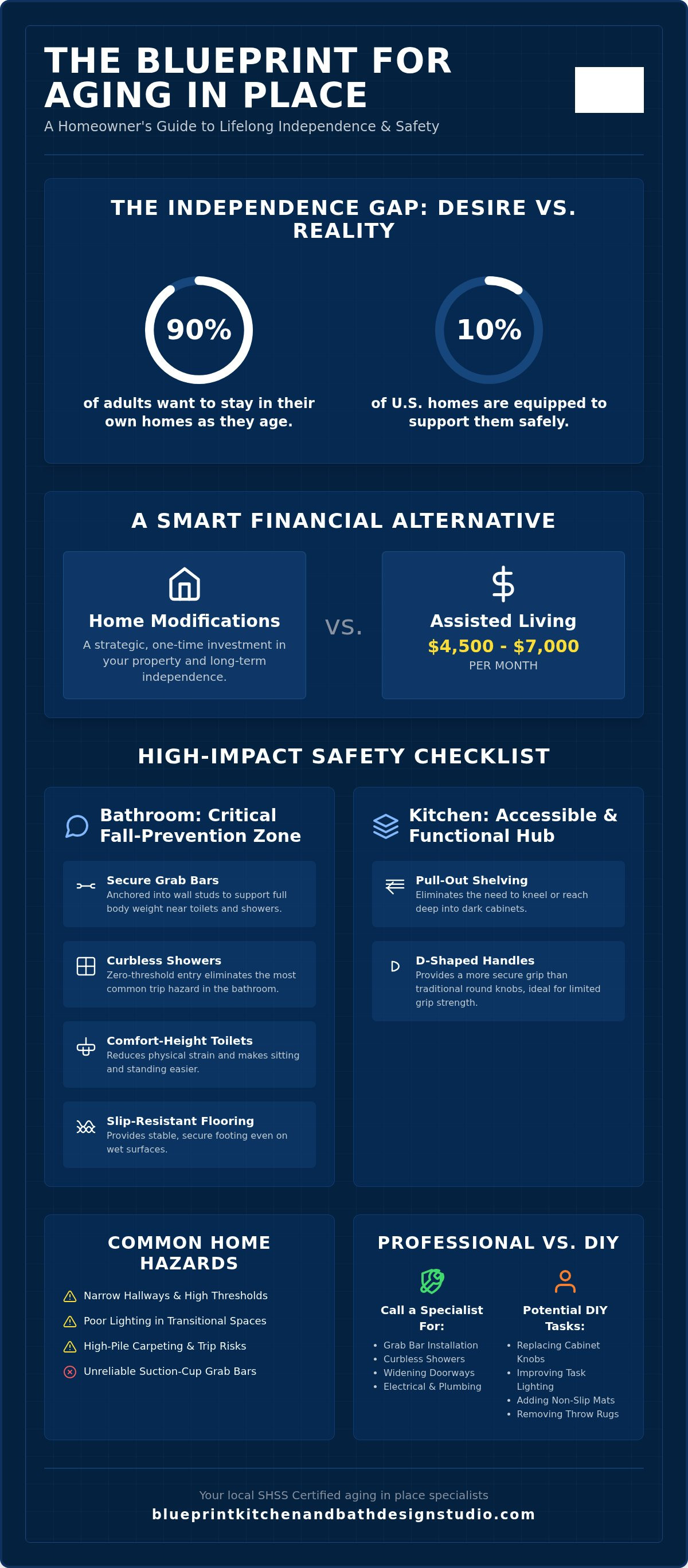
Did you know that while over 90% of adults want to stay in their own homes as they age, only 10% of American houses are actually equipped to support them? This gap often creates a sense of urgency for families in the Redlands area who are searching for a reliable aging in place checklist for homeowners. You want to stay in the neighborhood you love, but you don't want your living space to feel like a medical facility. It's natural to feel overwhelmed by technical choices or to worry about the cost of unnecessary renovations.
We believe that safety doesn't have to come at the expense of style. This guide provides a comprehensive strategy to transform your residence into a sanctuary of long-term independence. As SHSS Certified specialists, we've developed a room-by-room approach that prioritizes high-impact modifications like curbless showers and widened doorways. You'll learn how to identify critical hazards, choose elegant hardware that complements your decor, and create a prioritized plan that offers total peace of mind for you and your family.
Key Takeaways
- Discover why proactive home modifications serve as a strategic financial alternative to the rising costs of assisted living in 2026.
- Use our room-by-room aging in place checklist for homeowners to prioritize high-impact safety upgrades in the bathroom and kitchen.
- Learn how "safety meets design" through specialized installations like curbless showers and slip-resistant flooring that maintain your home's luxury feel.
- Identify when to move beyond DIY tasks to ensure critical hardware like grab bars are securely anchored for maximum stability.
- Gain a clear, three-phase roadmap for implementing accessibility features while navigating local building codes in the Redlands and Inland Empire area.
Understanding Aging in Place: Why a Proactive Checklist Matters in 2026
Choosing to remain in your own home as your physical needs change is a powerful statement of independence. Understanding Aging in Place involves more than just staying put; it's about transforming your environment to support your dignity and safety. For many homeowners in Redlands and the Inland Empire, 2026 marks a shift from reactive, emergency repairs to proactive, high-end design. Instead of waiting for a fall to occur, families are using an aging in place checklist for homeowners to identify structural barriers early. This allows for a graceful transition that maintains the home's aesthetic while enhancing its utility.
Many homes in our local area, particularly the older bungalows in Redlands or established estates in Loma Linda, feature architectural charms that eventually become functional obstacles. Narrow hallways and high door thresholds are common. While these details add character, they restrict mobility for those using walkers or wheelchairs. Addressing these issues now prevents the emotional and financial strain of a sudden relocation. With the average cost of assisted living in the United States ranging between $4,500 and $7,000 per month, investing in professional home modifications is a fiscally responsible alternative that preserves your equity and your freedom.
The Emotional and Financial Value of Staying Home
Staying in a familiar neighborhood maintains vital social connections and reduces the cognitive stress associated with moving. Beyond personal comfort, accessibility upgrades often increase a property's market appeal. Modern buyers look for universal design features like curbless showers and wide entryways because they accommodate everyone from young families with strollers to multi-generational households. Aging in place is a strategic home evolution that ensures your residence remains a sanctuary of long-term autonomy.
Identifying Common Red Flags in Your Current Layout
A thorough assessment often reveals hidden hazards that homeowners have overlooked for years. Poor lighting in transitional spaces and high-pile carpeting can significantly increase trip risks. You should also evaluate the "visitability" of your home. Can a friend with a mobility aid enter your front door or use your guest bathroom? Many people rely on "temporary" fixes like suction-cup grab bars. These are dangerous because they lack the structural integrity of bars anchored into wall studs. A comprehensive aging in place checklist for homeowners helps you replace these unreliable patches with permanent, aesthetically pleasing solutions that offer true stability.
The Room-by-Room Safety Audit: Your Essential Homeowner Checklist
A systematic audit is the foundation of any successful modification project. By breaking the home down into specific zones, you can address functional challenges before they become safety hazards. This home safety checklist approach ensures every square foot of your living space supports your independence. Using a comprehensive aging in place checklist for homeowners allows you to prioritize upgrades that offer the greatest immediate benefit.
Bathroom: The Critical Zone for Fall Prevention
The bathroom is statistically the most hazardous room due to wet surfaces and confined spaces. Prioritizing grab bar installation near the toilet and inside the bathing area provides essential points of stability. These bars must be securely anchored into wall studs rather than just drywall to ensure they can support full body weight. For those looking to eliminate trip hazards entirely, a curbless shower installation offers a seamless, zero-threshold entry that accommodates both current and future mobility needs. Adding comfort-height toilets and slip-resistant flooring further reduces the physical strain of daily routines.
Kitchen: Creating a Functional and Accessible Workspace
Your kitchen should remain a hub for social connection, not a source of frustration. Simple adjustments make accessing heavy pots and pans much easier for those with limited grip strength. Consider these specific upgrades:
- Pull-out shelving: Eliminates the need to kneel or reach deep into dark cabinets.
- D-shaped handles: Provides a more secure grip than traditional round knobs.
- Lowered counter heights: Creates a dedicated "work station" for seated meal preparation.
Optimizing the "work triangle" between the sink, stove, and refrigerator minimizes unnecessary steps and prevents daily fatigue.
Entries and Hallways: Ensuring Seamless Mobility
Seamless mobility depends on clear paths and easy access. An effective aging in place checklist for homeowners includes verifying that doorways are at least 32 to 36 inches wide to allow for comfortable wheelchair or walker clearance. Replacing traditional round door knobs with lever-style handles ensures that doors can be opened with a simple push. Finally, removing "lip" thresholds between rooms creates a smooth surface that prevents stumbles during late-night movements.
Lighting and flooring serve as the safety foundation for the entire house. Ensure that every hallway and staircase is brightly lit with motion-activated fixtures. These small changes significantly reduce the risk of disorientation during the night. If you're planning a more significant update, consulting with an accessibility design specialist can help you select slip-resistant materials that look beautiful while providing superior traction.
Professional vs. DIY Modifications: When to Call a Specialist
Many homeowners begin their journey by downloading a basic aging in place checklist for homeowners. It's a great starting point for identifying loose rugs or burnt-out bulbs. However, a clear line exists between minor maintenance and specialized structural modifications. While a general handyman can fix a leaky faucet, they often lack the clinical training required for high-stakes safety installations. Professional remodeling ensures that every change supports your body's specific movement patterns and long-term health.
The Risks of Improper Hardware Installation
Safety hardware is only as reliable as its mounting. For example, grab bars must be anchored directly into wall studs to withstand the force of a sudden fall. Drywall anchors, even those rated for high weight, can pull out under the dynamic stress of a slip. Similarly, improperly calculated ramp slopes or un-reinforced shower seats create new hazards rather than solving old ones. Specialized contractors are required for structural ADA compliance to ensure every modification meets rigorous safety and liability standards.
Why SHSS Certification Matters for Your Home
A general contractor typically focuses on square footage and building codes. In contrast, an SHSS certified home safety specialist performs a granular 240-point assessment. This process goes beyond a simple walk-through. It involves analyzing your gait and how you navigate specific "bottlenecks" in your home. An SHSS specialist utilizes an advanced aging in place checklist for homeowners to evaluate movement patterns rather than just measuring floor space. This level of detail is supported by the National Institute on Aging guide, which emphasizes the importance of professional planning for long-term safety.
Professionals also bridge the "aesthetic gap" that often scares homeowners away from accessibility projects. You don't have to choose between a home that looks like a hospital and a home that is safe. Specialized designers use high-end materials, such as designer-finish grab bars and integrated lighting, to ensure your modifications feel like a luxury upgrade. By prioritizing both form and function, we create spaces that offer peace of mind without sacrificing your personal style or the resale value of your property.
Strategic Planning: A 3-Phase Roadmap for Home Upgrades
Many homeowners feel paralyzed by the sheer volume of tasks on a standard aging in place checklist for homeowners. Attempting a total home transformation in a single month is rarely practical or necessary. Instead, we recommend a methodical, three-phase approach that balances immediate safety with long-term structural evolution. This strategy allows you to manage your budget effectively while ensuring that your home remains a sanctuary of independence. By breaking the process into manageable steps, you can make informed decisions without the pressure of a health crisis.
Phase 1: The "Low-Hanging Fruit" of Home Safety
The first phase focuses on high-impact, low-cost adjustments that can be completed quickly. Start by improving the lumens in every hallway and stairwell; bright, even lighting is your best defense against disorientation and falls. Next, secure or remove area rugs that don't have a dedicated non-slip backing. Finally, add basic safety hardware in high-risk zones, such as the bathroom. These small shifts provide immediate stability without requiring significant construction or structural changes to your floor plan.
Phase 2 & 3: Investing in Structural Independence
As you move into more substantial projects, the focus shifts toward senior home safety remodeling. Phase 2 involves targeted updates that improve daily ergonomics, such as replacing traditional round knobs with lever handles and installing slip-resistant flooring in wet areas. Phase 3 addresses the structural core of the home. This includes major projects like curbless showers, widened doorways, and permanent home access ramps. Coordinating these larger upgrades during a single renovation period often maximizes contractor efficiency and minimizes the overall duration of home disruption.
Prioritizing these modifications should be based on a combination of your current health and anticipated future needs. For example, if you're planning a kitchen update now, it's wise to include D-shaped pulls and pull-out shelving even if your grip strength is currently excellent. This proactive design ensures your home is ready for any changes in mobility before they become an emergency. A well-planned aging in place checklist for homeowners helps you stay ahead of the curve. If you're ready to create a personalized timeline for your residence, you can schedule a professional home assessment to identify which upgrades will offer the most significant impact for your unique layout.
Partnering with Local Experts in Redlands for a Safer Future
Local knowledge is the final piece of the puzzle. While a general aging in place checklist for homeowners provides a solid framework, applying it to the unique housing stock of the Inland Empire requires a specialized touch. Redlands, Yucaipa, and Loma Linda each have specific building codes and architectural styles that influence how modifications are implemented. Partnering with a local expert ensures that your renovations aren't just safe, but also compliant with municipal standards. This regional insight prevents costly delays and ensures that structural changes, like doorway widening or ramp construction, are executed with precision.
The Blueprint Advantage: Safety Meets Style
Blueprint Kitchen and Bath Design Studio specializes in a design-first approach to aging in place remodeling in Redlands. We believe that your home should reflect your personal taste, regardless of the safety features you require. Our team customizes accessibility solutions to match the high-end architecture found throughout Southern California. We view safety modifications as a lifestyle upgrade rather than a compromise. By integrating features like designer-finish grab bars and slip-resistant flooring that mimics natural stone, we help you maintain the beauty of your residence. Our commitment is to help Inland Empire residents stay in the homes they love without feeling like they live in a clinical environment.
Your Next Steps: From Checklist to Reality
Moving from a theoretical plan to a physical transformation requires professional guidance. While you can start the process by reviewing your own aging in place checklist for homeowners, the most effective strategy involves a collaborative effort. We recommend gathering your family for a planning session to discuss long-term goals and immediate safety concerns. This ensures everyone is aligned on the vision for the home and the steps needed to achieve it.
Once you've identified your priorities, the next logical step is to verify them with a certified specialist. A professional home safety assessment provides a detailed roadmap of necessary structural changes and aesthetic improvements. This expert review takes the guesswork out of remodeling and provides a clear path forward for your project. If you're ready to secure your independence, you can start your home safety journey with a professional consultation today. Our team is here to provide the peace of mind you and your family deserve.
Securing Your Independence with Intentional Design
Transforming your home is a journey of empowerment that ensures you remain in the community you love. By moving from a reactive mindset to a proactive strategy, you protect your safety and your family's peace of mind. We've explored how a phased aging in place checklist for homeowners simplifies this transition, focusing on high-impact areas like the bathroom and kitchen while maintaining the high-end look of your residence. Every modification, from curbless showers to anchored grab bars, serves as a foundation for your long-term autonomy.
As an SHSS Certified Specialist based right here in Redlands, Blueprint Kitchen and Bath Design Studio understands the unique architectural needs of Inland Empire homes. We bridge the gap between clinical necessity and aesthetic accessibility so your modifications feel like a seamless lifestyle upgrade. Ready to move from a list to a reality? Schedule Your Professional Home Safety Assessment with Blueprint to identify the most effective upgrades for your specific floor plan. Your home is your sanctuary; let's ensure it stays that way for years to come.
Frequently Asked Questions
How much does it typically cost to modify a home for aging in place?
Modification costs vary significantly based on the scope of the project and the materials selected. Industry data for 2026 suggests that doorway widening typically ranges from $500 to $1,500 per opening, while a complete accessible bathroom remodel can start around $8,000. These investments are often compared to the monthly cost of assisted living, which averages between $4,500 and $7,000. We recommend a phased approach to manage your budget effectively.
Will aging in place modifications make my home look like a hospital?
Modern safety modifications prioritize aesthetic accessibility, ensuring your home remains a beautiful sanctuary. We use high-end materials like designer-finish grab bars and integrated lighting that blend seamlessly with your existing decor. A professional aging in place checklist for homeowners focuses on universal design, which enhances the home's value for everyone. Your residence will look like a luxury upgrade rather than a clinical environment, preserving both your dignity and your property's resale appeal.
Do I need a permit for grab bar installation or doorway widening in Redlands?
Permit requirements in Redlands and the surrounding Inland Empire depend on the complexity of the project. Simple hardware installations like grab bars usually don't require a permit. However, structural modifications such as doorway widening or moving plumbing for a curbless shower typically involve local building department approval. Working with a local specialist ensures all work meets current California building codes and passes necessary inspections, providing you with long-term peace of mind and legal compliance.
What are the most important bathroom safety upgrades for seniors?
The most critical bathroom safety upgrades focus on eliminating trip hazards and providing stability. A curbless shower installation is often the top priority because it provides zero-threshold entry for those with limited mobility. Other essential features include professional grab bar installation near the toilet and shower, comfort-height toilets, and slip-resistant flooring. These modifications collectively address the highest-risk area of the home while supporting your daily routine with ease and confidence.
Can I install grab bars myself, or should I hire a professional?
While some homeowners consider installing grab bars themselves, hiring a professional is the safer choice for long-term stability. Specialists ensure that bars are anchored directly into wall studs, which is necessary to support the dynamic force of a fall. DIY installations often rely on drywall anchors that can fail under pressure. A professional also understands proper placement based on your specific gait and height, reducing the risk of injury or property damage.
What is an SHSS Certified Senior Home Safety Specialist?
An SHSS (Senior Home Safety Specialist) is a professional who has earned a gold-standard certification in home safety assessments. This designation means the expert is trained to identify hidden hazards using a comprehensive 240-point checklist. Unlike a general contractor, an SHSS specialist focuses specifically on how your physical needs interact with your home's layout. They provide a strategic roadmap for modifications that prioritize your independence and physical autonomy over simple cosmetic changes.
How long does a typical aging in place bathroom remodel take?
The duration of a remodel depends on the project's complexity. A simple grab bar installation can be completed in just a few hours. More extensive projects, like a full bathroom reconfiguration or a curbless shower installation, typically take between two to four weeks. We coordinate every phase of the construction to minimize disruption to your daily life. A clear timeline is always established during the initial design phase to ensure your home returns to normal quickly.
Are there any tax credits or grants for home accessibility modifications?
Several financial resources are available in 2026 to help offset the cost of home modifications. Taxpayers aged 65 or older may qualify for an enhanced senior tax deduction of up to $6,000 per person. Veterans can often access the VA HISA grant, which provides up to $6,800 for medically necessary alterations. Additionally, expanded ABLE account eligibility allows more individuals to use tax-advantaged savings for accessibility projects. We recommend consulting with a tax professional for specific eligibility details.
Disclaimer
This article provides general educational information and design inspiration, not project-specific professional advice. Costs, timelines, permit requirements, building codes, and product suitability vary by property and jurisdiction. Final scope, pricing, and specifications are established only through a written proposal or contract. Consult qualified professionals and local building officials before beginning work. Unless expressly identified as a completed Blueprint project, images are illustrative and may include stock photography, design renderings, or AI-generated imagery.


